
The essays in this series center on the theme of what C. G. Jung called the ‘Shadow’, the hidden dark element of the subconscious mind, and the need to transmute its energies in the cause of individuation and awakening. This essay and its companion piece are excerpted from my book The Inner Light: Self Realization via the Western Esoteric Tradition (Axis Mundi Books, 2014). They deal with the themes of shadow elements within the Western esoteric tradition and how they have reached a distorted expression in fictional literature and film, such as via Frankenstein, vampires, and werewolves, each of which can be understood as the ‘lower octave’ of the Body of Light, tantric communion, shapeshifting/deity yoga, and other legitimate esoteric practices of the great initiatic traditions.
It was on a dreary night of November that I beheld the accomplishment of my toils. With an anxiety that almost amounted to agony, I collected the instruments of life around me, that I might infuse a spark of being into the lifeless thing that lay at my feet.
—Mary Shelley’s Frankenstein
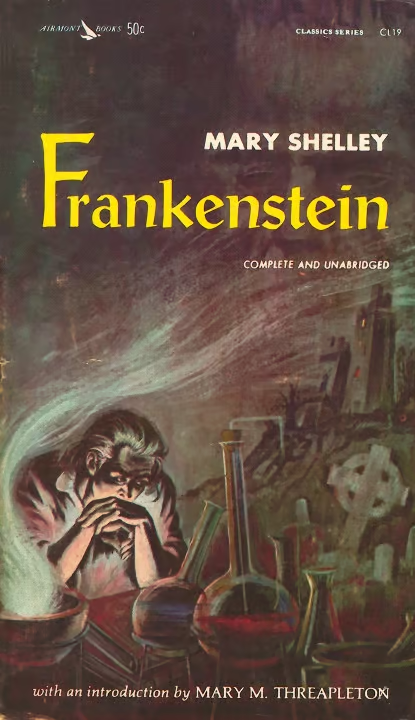
In some respects, Frankenstein, originating in Mary Shelley’s classic early 19th century novel, is the prototype of both the modern horror creature and modern stories of the supernatural. As a film, it represented as best as any the warping, cloaking, and sensationalizing of legitimate and important ideas from the mystical and occult traditions.
The story is unique in how its title, a name which refers to a fictional Swiss scientist (Victor Frankenstein) who creates a creature that he loses control of, long ago came to be confused with the creature itself. This creature is no ordinary creature, but in fact a terrible monster, and one that has inhabited the imagination of many a child influenced by ‘monster stories’ and has made for many a Halloween-party costume. The first film version of the story appeared in 1910, with Charles Ogle playing the monster. It was made by the Edison Company, owned by Thomas Edison, the seminal scientist and businessman whose genius was behind the development of both the light bulb and the motion picture camera—a perhaps fitting link with the science-fiction theme of inspired yet mad creation behind Shelley’s monster. The more iconic Frankenstein film appeared in 1931, starring Boris Karloff (1887-1969) as the monster. (Despite his Russian-sounding name Karloff was actually an Englishman; his birth name was William Pratt). It is from the 1931 film that the stereotypical look of Frankenstein’s monster was first created. Since then some forty movies have been shot featuring Frankenstein’s monster. The classic Frankenstein’s monster look was even mimicked in the T.V. comedy show The Munsters (1964-66) by the character Herman Munster (played by Fred Gwynne).
Origins
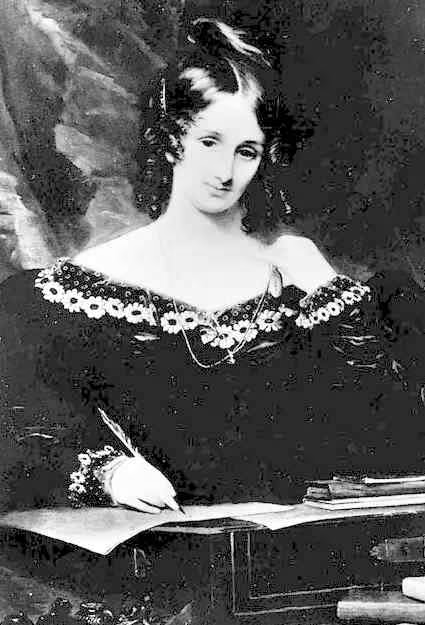
Frankenstein: or, The Modern Prometheus—viewed by many as the most influential modern fictionalized treatment of the occult—was the creation of a teenage girl. It was written by English novelist Mary Shelley (nee Godwin, 1797-1851). She began the novel in mid-1816 at age eighteen and finished it a year later. (This is more impressive than it may sound: between 1816-17 she gave birth to two children, got married, and lost her half-sister to suicide). It was first published in 1818 when she had not yet turned twenty-one; this first edition was brought out anonymously. Her husband, the renowned poet Percy Bysshe Shelley, encouraged her writing and wrote the Preface. Mary Shelley was credited as author only in the second edition which was brought out in 1823.1 A further revised edition was published in 1831, in which some of the language in the first part of the story was toned down.2
The origin of the story lies in a series of meetings between Shelley, her husband Percy, the Romantic poet Lord Byron, and two others. The group had been reading and discussing German ghost stories in French translations, when Byron proposed that they all attempt to create their own ghost story. Mary Shelley initially experienced a block in her imagination and for several days was unable to come up with anything. One night she listened to her husband and Byron discuss the possibilities of galvanism and related matters. (Galvanism, a term coined in the late 18th century, referred to the idea of stimulating muscles via applying an electric current to them, and to the possibility of animating dead tissue via electricity. The word was taken from the discoverer of bioelectricity, Luigi Galvani, who in 1791 first published his study showing how nerve cell signals passed to muscles are electrical in nature. The modern term, electrophysiology, is the study of the electrical properties of living cells). Shortly after, Shelley conceived of her idea of the story of a scientist who constructs a living creature from derelict organic parts. The outline of the story came to her in a series of visions while she lay in bed unable to sleep, having fallen into a light trance state.
The novel is a classic of 19th century horror. Some have even attempt to portray it as the first science-fiction novel, although in fact the book barely qualifies as science-fiction, as there is no real attempt at ‘science’ anywhere in its text, even the ‘techno-babble’ science typical of the genre; it rather leaps straight to the end result, the creation of the monster, thereafter being one extended commentary on the results of such a creation. The subtitle of the book, or, The Modern Prometheus, refers to the Greek god (one of the Titans) who brought fire to humanity by stealing it from Olympus, an act for which he was severely punished by Zeus. The early 20th century occultist and artist, Austin Osman Spare, once defined magic as the art of ‘stealing fire from heaven’, a reference to the Prometheus myth.3
Shelley did not originally set out to write Frankenstein with any serious intention to express esoteric ideas; she simply wanted to write a good horror story. In her Introduction to the revised 1931 edition, she admitted, following her meetings with Percy Shelley and Lord Byron,
I busied myself to think of a story—a story to rival those which had excited us to this task. One which would speak of the mysterious fears of our nature and awaken thrilling horror—one to make the reader dread to look around, to curdle the blood, and quicken the beatings of the heart. If I did not accomplish these things, my ghost story would be unworthy of its name.4
Her husband added that the entire brain-storming sessions that led to his wife conceiving Frankenstein were conducted in the spirit of playfulness:
…We crowded around a blazing wood fire and occasionally amused ourselves with some German stories of ghosts which happened to fall into our hands. These tales excited in us the playful desire of imitation.5
Notwithstanding the spirit of its origins, the novel, despite a mixed critical reception, was an immediate bestseller and grew to have lasting iconic influence. In addition and more importantly to our concerns here, the connection between Frankenstein as penned by Shelley, and the Western esoteric tradition, is clear. Shelley has the protagonist of her novel, Dr. Frankenstein, studying such major occult luminaries as Albertus Magnus, Agrippa, and Paracelsus. When Frankenstein sets about achieving his great creation (and ultimately, monster), he utilizes both science (chemistry) and alchemy. Shelley took this from Paracelsus’ actual attempts to create an artificial man (see below).
That said, the general attitude of the book, as expressed by Victor Frankenstein, is progressive, and Shelley was very aware of the movement from mystical alchemy to practical chemistry. In the novel, young Victor discovered Agrippa’s occult writings as a boy, and excitedly reported them to his father, who disapproved, remarking,
‘Ah! Cornelius Agrippa! My dear Victor, do not waste your time upon this; it is sad trash’.6
Victor was unimpressed with his father’s lazy and disdainful attitude, however, and he continued to study Agrippa, as well as Paracelsus and Magnus.
I read and studied the wild fancies of these writers with delight; they appeared to me treasures known to few besides myself.7
But this thrill was not to last. Soon after young Victor witnessed an oak tree being destroyed by a lightening bolt. It just so happened that a man ‘of great research in natural philosophy’ was with him at the time, and he proceeded to explain to Victor some basics of electricity and galvanism. Victor was so impressed that for him, Agrippa and the occultists and alchemists and other ‘lords of my imagination’ were overthrown.8 He then determined to devote himself passionately to the study of ‘that science as being built upon secure foundations, and so worthy of my considerations’.9 He later on is admonished by a professor of natural philosophy for having wasted time studying the nonsense of alchemists. But Victor is young, beneficial in this case because his youth prevents him from becoming too rigid. He retains some suspicion about the merits of modern science, and is not altogether convinced about the so-called fallacies of the occultists and alchemists. Concerning the contempt of his professors for the occult arts, Victor remarks, ‘I was required to exchange chimeras of boundless grandeur for realities of little worth’.10 To counter this, another of Frankenstein’s professors proclaims:
‘The ancient teachers of this science [the occultists and alchemists] promised impossibilities and performed nothing. The modern masters promise very little: they know that metals cannot be transmuted and that the elixir of life is a chimera.’11
Victor later on meets up privately with this professor, who reveals his admiration and appreciation for Agrippa, Paracelsus, and their like, saying,
‘The labors of men of genius, however erroneously directed, scarcely ever fail in ultimately turning to the solid advantage of mankind’.12
Victor then devotes himself wholeheartedly to the study of modern chemistry, at which he excels. He then learns how to vitalize and bring life to dead body parts, which in so doing, eventually leads to his creation of the monster, something he had originally hoped to be beautiful, but which turns out to be hideous. Disgusted, Victor abandons the monster. This monster is sentient, however, and is deeply confused, hurt, and angry at the isolated predicament he finds himself in. The rest of the novel basically centers on the monster’s quest for vengeance (in so doing, murdering several people close to Victor, but not without first appealing to Victor to create a companion for himself, so as to relieve him of his great loneliness. Victor considers doing so, but decides against it). The novel ends with Victor, bent on destroying his creation, dying of illness on a boat in the Arctic. The monster is devastated by Victor’s death, and vows to destroy himself. He jumps onto an ice raft, and disappears.
There are several important conventional themes in Frankenstein. These are:
- The creation of life and sentient intelligence by the human hand, employing science.
- The loss of control of this creation, and a general reflection on the dangers of science without adequate conscience.
- Reaction to appearances, and the power of perception to mold our experience. (Victor Frankenstein is initially repelled by the appearance of his creation, and cannot overcome this reaction, leading to his abandonment of the creature, and its subsequent desire to seek vengeance for this).
The esoteric themes in Frankenstein are also there, if less obvious:
- The need to distinguish between the inner sciences (occultism and alchemy in particular) and the outer sciences (chemistry in particular), by not confusing domains of experience and consciousness.
- The esoteric meaning of the ‘golem’ and the ‘homunculus’.
- Overcoming mortality via the science of inner creation (the ‘Body of Light’).
- The Gnostic theme of flawed creation, via the Gnostic myth of the Demiurge who created the universe, and the passive role of the ‘true God’.
Occultism and Alchemy
These areas of study are notoriously misunderstood. On the one hand, there are the credulous who, lacking the capacity for critical thought (or angrily rebelling against it), are willing to embrace any paradigm, no matter how bizarre. Many of these may seem to conform to James Webb’s view of occultism as a realm of refuge for those disturbed by the dehumanizing elements of science. Occultism, with its central philosophy of ‘Man is a microcosm of God’, seems a safe vanguard against the cold mechanicality of the hard sciences. (Copernicus, Galileo, and Darwin may have seriously diminished the importance of the human being in the cosmic scheme of things, but occultism and the great esoteric traditions are based entirely on Shakespeare’s ‘Man is the measure of all things’).
On the other hand, there is the conventional academic view of occultism, alchemy, and related matters as little more than primitive proto-sciences, ignorant and base attempts to escape the dark dogmas of religion, but not yet at the intellectual honesty of ‘true’ science. This at times condescending perspective suffers from a surprisingly simple defect, that being the failure to differentiate domains of conscious experience (such as the subjective from the objective). It’s as if it rarely or never occurs to those who put forth this view that real occultism and alchemy were about more than just primitive attempts to gain power by manipulating matter.
There are, in fact, several levels of understanding within the occult sciences; the most profound of these are best described as esoteric traditions. The word ‘occult’ simply means ‘hidden’ or ‘secret’. The word ‘esoteric’ means ‘inner’, and in reference to spiritual teachings, refers to the inner teachings accessible to those ready to look deeper into their own nature. (Jesus even makes reference to this in the New Testament, when he says, ‘He who has ears, let him hear…’). In the spiritual realm, that the ‘inner’ has frequently meant ‘hidden’ or ‘secret’ has been natural, if for no other reason due to the intolerance shown by the Christian church, in particular, down through the centuries toward esoteric teachings. These teachings became hidden and secret for a reason, a reality perhaps never better demonstrated than by the discovery of the famed Gnostic Gospels in a cave in Nag Hammadi, Egypt, in 1945, where they had been secreted away for some sixteen centuries to escape the book-burning edicts of the Church that began around the 4th century CE.
The essential difference between the esoteric paths (Gnosticism, alchemy, Kabbalah, and so forth) and mainstream Western religion (orthodox Jewish, Christian, and Islamic doctrine) is the role of the individual in relation to Divine. The esoteric paths aim to guide the individual into a realization of their true nature, which is viewed as ultimately being ‘at one’ with the Divine. Conventional Western religions do not teach this, and regard any such lofty spiritual ambition as both foolhardy and heretical. One of the great Christian mystics, Meister Eckhart (1260-1327), was declared heretical by Pope John XXII two years after his death, in part for ‘revealing secrets’ and in part for teaching the core esoteric doctrine that Man and God can be, essentially, One. For a person awakened to their true nature, Eckhart wrote ‘There is no difference between him and God; they are one’.13
The occult tradition is ultimately about the study of the deepest truths of consciousness—essentially, the science of the inner realms. The word, however, has been notoriously tarnished, and in particular by the media of film and popular literature. Worse, it tends to get associated, consciously or not, with the word ‘cult’, even though the two words do not share a common etymological root. (‘Occult’ derives from the Latin occultus, meaning ‘hidden’ or ‘secret’; ‘cult’ springs from the Latin cultus, a word with various meanings, including ‘culture’, ‘worship’, and ‘reverence’). The word ‘cult’ in modern times is usually used in a pejorative fashion, essentially referring to any organized group that is demonstratively destructive, or more subtly, one simply disagrees with (or condemns).14
One of the more important branches of occultism down through the centuries has been alchemy. This is an ancient field of study and practice that has roots in China, Egypt, central Asia, and Europe. Alchemy is regarded by modern day science as the precursor of chemistry, and this is undoubtedly true to some degree. However alchemy has different levels to it. There is the strictly physical element that has been concerned with things such as manufacturing gold (more the European focus), or producing an elixir that could result in bodily immortality (more the Oriental concern). There is also the esoteric alchemy, concerned with spiritual transformation, in which the physical alchemical elements (sulfur, mercury, salt, and so on) and rich alchemical symbolism (green and red lions, dragons, hermaphrodites, etc.) are understood to represent psycho-spiritual realities and processes of personal initiation and transformation. This inner aspect of alchemy came to be increasingly abandoned, especially around the time Shelley was writing Frankenstein, in the wave of general excitement connected to the birth pangs of modern science. The Hermetic Order of the Golden Dawn (an occult society founded in 1888 by three London Freemasons) taught spiritual alchemy to some extent in its ‘knowledge lectures’, but it was the Swiss psychotherapist Carl Jung who openly rescued alchemy from oblivion in the mid-20th century, brilliantly revealing its symbolic depth and treating it as a means for psychological interpretation. (Jung wrote a great deal on alchemy, writings collected mostly in his works Psychology and Alchemy and Mysterium Coniunctionis).
In the novel, young Victor Frankenstein initially embraced the occult arts, then waffles between them and modern chemistry, until finally coming over to the new science for good, leading up to the creation of his monster. The figures of occultism Shelley mentions in the novel were chiefly Agrippa, Magnus, and Paracelsus. Heinrich Cornelius Agrippa (1486-1535) was an important German magus, alchemist, and author of the vastly influential Three Books of Occult Philosophy (written by 1510, first published in complete form in 1533). The book is a massive Renaissance encyclopedia of ritual magic, and is the main source book for most significant schools of Western occultism since the 19th century.
One of Agrippa’s chief predecessors was Albertus Magnus (1200?-1280), Dominican bishop, theologian, philosopher, and magus. Albertus died in Cologne, the same German city that Agrippa was born in, raising the possibility that the latter had paid homage, in his youth, to the tomb of the former (which can be seen to this day in the crypt of St. Andreas church), given how consumed with the occult sciences Agrippa had been at a young age—he wrote Three Books of Occult Philosophy at around twenty years old, similar to the age Shelley was when she published the first edition of Frankenstein. Albertus had been a marked influence on two pillars of Western civilization, the Italian poet Dante (and Mary Shelley was reading Dante when she was working on Frankenstein) and the Catholic theologian Thomas Aquinas (who had been a direct student of Albertus). In addition to being a religious ‘authority’, Albertus was a great scholar, considered one of the most widely learned men of his time. He is known to have embraced astrology as an occult science, although this is not unusual for his time, when astrology was held in the same esteem that astronomy is today.
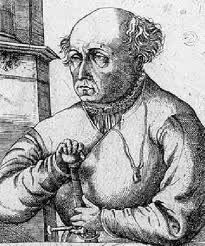
Paracelsus (1493-1541, seen above)—whose full name was the marvelously bombastic Philippus Aureolus Theophrastus Bombastus von Hohenheim—was an important Swiss botanist (considered the first), alchemist, occultist, and philosopher. Though is generally credited with being one of the key figures bridging ancient physical alchemy with the first glimmerings of modern chemistry, he was firmly within the paradigm of the Renaissance wizard conjuring up great things in his laboratory.
An interesting folktale has been noted by some literary critics: Albertus allegedly discovered an alchemical elixir (a version of the ‘philosopher’s stone’) that he used to bring a brass statue to life. This statue, a type of robotic-servant, eventually learned speech but became a talkative nuisance and was, one day, destroyed by a vexed Thomas Aquinas with a hammer.15
Victor Frankenstein is very much modeled on the figure of Paracelsus (and to a lesser degree, Agrippa). And as we shall soon see, that connection is no accident, as Paracelsus had an interest in the creation of the artificial entity—an idea bearing notable resemblance to Shelley’s monster—known as the homunculus.
The Homunculus
The term ‘homunculus’ is Latin for ‘little human’. Its origins are connected to the idea of a miniature, yet fully formed, life form. The root here is the philosophical notion found in early biology called preformationism, which is the idea that the form of an organism exists first, in miniature (a sort of physical parallel of Plato’s idea of the prototypical ‘forms’ that exist as archetypal templates on subtle, invisible levels of reality). For example, preformationism held that inside of a sperm cell exists a tiny, fully formed human body. It was speculated that when the sperm entered a woman, this ‘tiny human’ simply grew into an infant eventually ready for physical birth. However, someone eventually deduced that if this tiny person (homunculus) was fully formed, it too must possess sperm which in turn would contain yet more little fully formed human bodies (homunculi). As in the Hindu myth of the world being supported on the back of a turtle, it would then be ‘turtles all the way down’ (what supports the turtle? Another turtle, and so on). Such an idea is, naturally, absurd.
(This in turn extends to something called the ‘homunculus fallacy’. It is the idea that we cannot truly argue that a ‘person’ exists inside of us deciding which thought to have at any given moment. For example, we think of a tree. Where did this thought come from? From the ‘person’ inside of us who decided to have this thought. But then how did this ‘inner person’ come to create the thought that we as the ‘outer person’ register as ‘thinking about a tree’? It must be because there was a yet ‘smaller’ person inside of the ‘inner person’, deciding to think about a tree. And so on, ad absurdum, in what is called an ‘infinite regress’. Clearly, there must be a point where the thought of a ‘tree’ simply appears, without being generated by any ‘inner person’).
The idea of the homunculus is found in Renaissance-era alchemy, and in related fictional works, such as Goethe’s Faust, where Faust’s student (Wagner) creates a homunculus to perform certain tasks. Goethe likely got the idea from Paracelsus who made mention of it in his writings. Paracelsus had laid out a primitive formula for creating a homunculus, based on a mixture of putrefied semen, horse manure, and human blood. As a proto-scientist he was attempting to show that he could create life, and useful life at that (not dissimilar to a modern engineer constructing a robot). In so doing, he was trying to naturalize the supernatural approach to the creation of magical creatures. (On the physical level he of course failed, and in 1859, Louis Pasteur proved that spontaneous generation—life from inanimate matter—is impossible. However the question of where life ultimately originated from is of course unresolved).
The Golem
The idea of creating an artificial person from dead matter has a precedent in a number of old magical traditions, but was especially developed in the Jewish mystical tradition, where it was called a ‘golem’. (The name of Tolkien’s strange creature from The Lord of the Rings, Gollum, was probably taken from this). The word translates from Hebrew as ‘shapeless mass’ or ‘imperfect substance’. The typical idea of the golem, as originally found in Jewish magical folklore in 13th century Germany, was that it was an artificial life form created to serve a magician or wizard. The modern technological equivalent of this would be a robot or machine constructed to serve a human. Some of the old Kabbalistic sources maintained that the golem could be given vitality by a human, but not ‘spirit’ or ‘soul’, a view that would seem to accord with comparisons with modern-day robots.16
The golem was believed to be activated by the power of specific magical words, and deactivated in a similar fashion. Some legends had the Hebrew word emet (‘truth’) inscribed on the forehead of the golem, which activated it; in order to deactivate it, the first letter (alef) of the word emet was removed resulting in the word met (‘dead’). (The usage of special words to activate/deactivate the golem is reminiscent of the code-writing behind computer programs).
According to Kabbalah scholar Gershom Scholem, there is no real evidence from any of the early sources that the golem was used for any actual practical purposes. It was seen more as a symbolic act of creation, a demonstration of mastery of inner power brought about by mystical awakening.17 It was in some respects similar to Paracelsus’s attempts to create a homunculus, and thereby demonstrate ‘God-like’ powers.
In the Talmudic tradition, Adam was recognized as the first ‘golem’, until his body was instilled with a soul. (In Genesis, the first human, Adam, is created from earth and breath. God fashions him from the dust/mud/earth, and then breathes life into his nostrils. The earth is the body; the breath is Spirit/soul/consciousness). The word ‘golem’ occurs once in the Hebrew Old Testament, in Psalms 139:16. The English translation is:
Thine eyes did see my substance, yet being unperfect; and in thy book all my members were written, which in continuance were fashioned, when as yet there was none of them. (KJV)
The Contemporary English Version offers a more comprehensible if less poetic translation:
but with your own eyes you saw
my body being formed.
Even before I was born,
you had written in your book
everything I would do.
It is homage to God, as the supreme Creator of life. In some ways, it refers to the ultimate mystery, the creation of life from non-life; or the creation of something from nothing. This interpretation gives the key to a closer understanding of the spiritual meaning behind the symbolism of the golem or homunculus; and by extension, with the debasement of the idea, symbolized by Frankenstein’s monster.
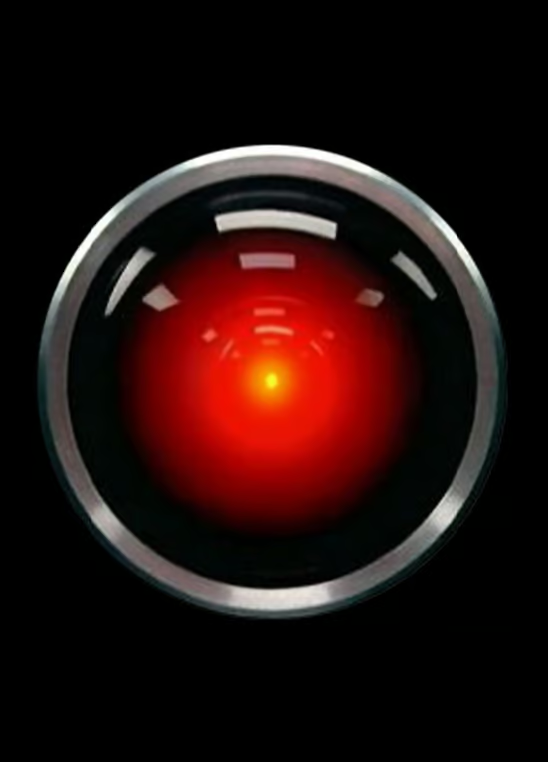
In the iconic 1969 science-fiction film 2001: A Space Odyssey (one of Stanley Kubrick’s masterpieces, based on a short story by Arthur C. Clarke), an advanced supercomputer, called HAL9000 (‘Hal’ for short, his iconic image shown above), accompanies a small squad of astronauts on a lengthy journey to Jupiter. Hal eventually malfunctions and turns against his masters, killing all but one. The remaining astronaut successfully deactivates Hal toward the end of the movie, before himself going on a journey through a type of ‘stargate’ or inter-dimensional portal.
Hal is the classic modern (or futuristic) version of the technological ‘golem’ gone bad. Mary Shelley’s tale has been seen by some as a morality play cautioning against the dangers of aggressive and single-minded ‘masculinist science’—a speculation finding some support from the fact that Shelley’s mother, Mary Wollstonecraft (1759-97) was a founding figure of modern women’s liberation (her best known publication being A Vindication of the Rights of Woman).18 But Shelley’s fable ultimately points toward something much more subtle than that.
Resurrection and The Body of Light
The Jewish golem and the alchemical homunculus have in common the idea of artificial creation, and in specific, the ambition of a human creator to attain God-like power via the act of creating a person, or person-like entity, himself. It symbolizes, in some respects, the culminating act of the magus or wizard: to co-create with God.
In many Gnostic and esoteric traditions a serpent, or specifically, the serpent from the Book of Genesis, is understood to be a key teacher. According to these esoteric teachings, the serpent is a figure much maligned in many mainstream religions, where it is confused with an evil principle involved in misguiding the human race. A key to all this can be found in the well-known section of Genesis where God warns Adam and Eve not to eat a particular fruit in the Garden of Eden. Eve goes so far as to report this warning to the Serpent, adding that God specified not to eat fruit from the specific tree in the middle of the garden. The Serpent then takes it upon himself to countermand this edict, declaring,
…You will not surely die. For God knows that in the day you eat of it your eyes will be opened, and you will be like God, knowing good and evil. (KJV, 3:4-5).
This passage as well as any captures the underlying aim of the magical, occult, and esoteric traditions. A wizard is a ‘wise person’; a magus is one who serves the divine by being attuned to it. Even the Eastern term ‘swami’ means ‘lord of himself’. The point of the esoteric path is to confront, embrace, and master all elements of oneself, in so doing awakening to the highest principle of Being, what is sometimes known as the ‘higher self’, ‘soul’, Holy Guardian Angel, or via many other appellations.
The famous Hermetic maxim is as above, so below. This expression is understood by occultists to denote many things, but above all it refers to the idea that a person is a miniature image of God, holding latent within all the potential of the Divine. Recall from our discussion above that the homunculus is a miniature version of a person. In the Hermetic view, a person is therefore a type of ‘homunculus of God’. As the person is created by God (according to traditional theism), so too a wizard can create a life-form, and thus demonstrate God-like capacity.
This, however, is the corrupted or debased understanding of the Hermetic principle, and Mary Shelley provided a vivid allegory of what happens when this debased principle is pursued single-mindedly.
The uncorrupted esoteric element found deep within Shelley’s Frankenstein in latent form is the idea of the creation of the ‘Body of Light’. This is a concept that appears in many esoteric traditions, both West and East, and it is generally connected to the intention to enable easy transition for the soul from the death of the body to the journey into the Afterlife and beyond.
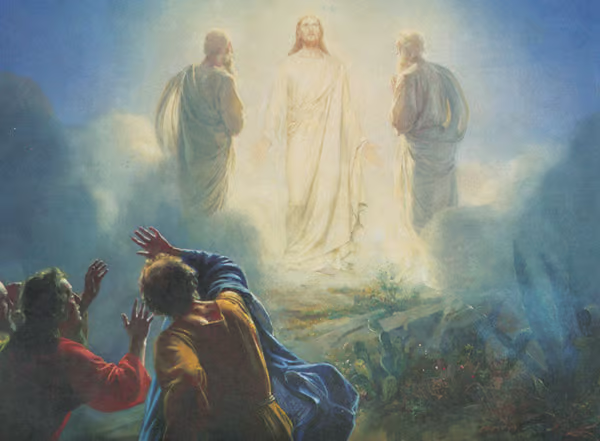
It was the ancient Egyptians who created an entire religion around conquering death, most clearly shown in the myth of Osiris, the resurrected god. This idea of resurrection appeared in other traditions, but most essentially in Christianity, via the mythology of Easter and the legend of the risen Christ via his ‘ascension body’. Christ’s Body of Light was also suggested in the well known ‘transfiguration scene’ (Mark 9:2-3):
Now after six days Jesus took Peter, James, and John, and led them up on a high mountain apart by themselves; and He was transfigured before them. His clothes became shining, exceedingly white, like snow, such as no launderer on earth can whiten them. (KJV)
The idea of the Body of Light is also found in many Eastern traditions, where it is given names such as the Diamond Body, or the Rainbow Body. It can be thought of as a form of subtle energy that is created by a practitioner of inner spiritual sciences. We are not simply born with it. (The Greek-Armenian mystic G.I. Gurdjieff was referring to this when he maintained that we are not born with a soul, but rather must create one by our spiritual practices). Above all, it represents the ability of awakened consciousness to exist independent of material reality.
Esoteric practitioner Dolores Ashcroft-Nowicki described it this way:
‘…There is another form used by some magicians, the Body of Light. Some think that it is the same as the astral body, but it is in fact quite different. The astral is an etheric form common to everyone, a [Body of Light] is acquired through practice and concentration. The Body of Light is deliberately built for a purpose…it is not easily formed, some people never manage it, or at least not fully, and once it is formed it can be troublesome, and requires firm handling.’19
On one level, the Body of Light can be thought of as symbolic of the accumulation of our purity of intent. It is the ‘vehicle’ that enables our return to primordial unity with the source of consciousness. It is the ‘inner body’ of wisdom and awakened consciousness. The polar opposite of this—what may be called the debasement of the principle of transcendence—is an artificial ‘outer body’. In effect, a monster.
The Body of Light, or the Resurrection Body, is based on the essential idea of the spiritualization of matter. This is ultimately brought about not just by pursuing arcane esoteric practices, but more importantly by mastering our lessons on planet Earth. We do not ‘graduate’ to higher levels of being by escaping this world, but by embracing our lessons in total.
Gnostic Wisdom
The ‘golem’ carries profound symbolism, and this can perhaps best be understood via certain Gnostic ideas around the creation of the universe. According to most Gnostic traditions, the ‘true God’ did not create the universe. It was created rather by a lesser being, an archangel named Ialdabaoth, who is sometimes identified with Yahweh of the Old Testament. Most Gnostic traditions have Christ entering the world as cosmic Redeemer, enabling souls ‘trapped’ in the matter of this ‘flawed’ universe to return to the primal and perfect Unity of the true God.
What do we make of this seemingly strange myth? At quick assessment, it’s not difficult to sympathize with the reasoning behind it. It will be apparent to at least some objective observers that the universe is anything but ‘heavenly’, based as it is on cold laws of physics and equally harsh biological realities (such as organisms being required to eat other, often protesting, organisms in order to survive). Destruction and death is part of the fabric of our reality. It is perfectly reasonable (whether true or not) to argue that a ‘perfect’ God would not create such a reality.
But that does no good for the existential reality we find ourselves in. We have to ‘deal with’ the life we are living, and the universe we find ourselves part of—warts and all. That said, the key point is to understand how we are in fact ‘dealing with’ this reality. How exactly do we construct our perception and experience of it, and how exactly are we comporting ourselves within this constructed experience?
To generate delusions and illusions with faulty thinking is, in effect, to create a ‘monster’ reality in which to live. Gurdjieff referred to this as ‘the terror of the situation’. In short, most of us are either asleep or crazy, or some combination of both. The reality we have constructed, both individually and collectively, is a pitiful semblance of our almost limitless potential. For most of us there is nothing ‘spiritual’ about our actual existence, and that is true even for many who fancy themselves on some sort of ‘spiritual path’.
The monster in Frankenstein, grimacing and angry as he stumbles about seeking revenge on his neglectful master, can be seen as a type of allegory of our generally debased spiritual condition, as well as our unconscious attitude toward God (and even lesser symbols of authority). In conventional Western religious paradigms (Judaism, Christianity, Islam) God is absolutely external to the personal self, even from the ‘soul’ of the individual. From this perspective, there is no room—none at all—for negotiating any sort of ‘Oneness’ with God. The only approach to the Lord is via surrender, or more pointedly from our egocentric perspective, via submission. Apologists for this position argue that our ego-centricity is too deep, too ‘hardwired’ into us, for any other approach to work. The Lord created us, and we must never forget this. ‘You shall have no other gods before me’.
The Western esoteric traditions—essentially Jewish Kabbalism, Gnostic Christianity, and Islamic Sufism—propose a different paradigm, one that describes Reality as being ultimately non-dualistic. That is, our true and ultimate nature is at One with God. The ultimate purpose of the ‘spiritual path’, via whatever route and whatever disciplines, is to realize this Oneness. Most of these esoteric traditions do acknowledge, however, that this path is extremely difficult to navigate successfully to the end, being fraught with the temptations common to the egocentric self, and with the sheer difficult of facing up to the depths of our egocentricity (necessary if we are to overcome it and penetrate the ‘veil’ between our conventional self and our divine condition).
I am not here concerned with comparatively evaluating the pros and cons of the orthodox religious paradigm (God as the Supreme Separate Being) or of the esoteric paths (we are God at the inmost core of our being). What interests me more is seeing the ways in which spiritual paradigms (including all grotesque distortions) are propagated into society by means other than standard religious education.
Memes and the Monster Legacy
A ‘meme’ is an idea that transmits within society from person to person (the term was coined in 1976 by biologist and noted atheist Richard Dawkins; he derived it from the Greek mimema, meaning ‘something imitated’). It could be said to be a type of education via word of mouth. Any self-employed person knows that the most effective form of advertising is word of mouth (as does any large-scale corporation, despite how much they may spend on standard means of advertising). Along with fictional literature, the movie industry has always been a powerful generator of memes, and in our current age of advanced communications and social networking, memes appear and disappear on a weekly basis (and some of them even stick).
Certain memes generated by the movie industry have effectively worked to obscure teachings from the esoteric traditions. The original monster from Shelley’s book was talkative and intelligent, and able to move quickly and fluidly. The movie monster, deriving from Karloff’s stiff-limbed lumbering and hideous behemoth, appears anything but. Shelley’s monster was sensitive and introspective (and literate; it had even read Milton’s Paradise Lost), and its main quest was for love and union with a mate. From the beginning of its creation it experiences nothing but rejection, first from Dr. Frankenstein, and later from every other human it meets. This constant rejection leads the monster to vengeance and murder.
In the 1931 film, the monster is mute, and remained more or less so in all subsequent sequels, except for the first of these (the 1935 Bride of Frankenstein, where the monster learned limited speech. It was once again mute in the follow up sequel, the 1939 Son of Frankenstein). What was originally an allegory about misguided creation, rejection, vengeance, and a vexing and troubling quest for meaning, became, via the Silver Screen filter, an exercise in base fear and primitive aggression. Shelley’s thoughtful and sensitive creature descended into a murderer in her novel, but it was fundamentally intelligent—and had been created by a man who was versed in both science and the mysteries of ancient occultism. The movie monster was mostly a vehicle for freakish frightfulness.
The Frankenstein myth has spawned many modern versions of the golem or closely related ideas—a good example being The Norliss Tapes (1973), an obscure (but memorable) horror film about a writer who, while researching a book, is contacted by a recently widowed woman. The woman’s husband, an artist, has been ‘coming back to life’ recurrently as a grotesque zombie. In between his zombie night-prowls and his retreating back to his crypt by day, he is creating a type of golem—an artificial man constructed from clay. The zombie-husband works on this golem right up to the end of the film when he and the golem are destroyed by the private investigator who traps them in a circle of blood and fire. Vague references are made a few times in the film to ancient Egyptian mythology, but these are never elaborated on (much how Shelley never elaborated on the occult teachings of Agrippa or the alchemy of Paracelsus).
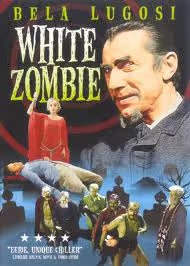
Technically speaking Frankenstein’s monster was not a zombie, as a zombie is a corpse brought back to life. Frankenstein’s monster was never a whole life form; it was a revived amalgam of a number of dead parts. But the relation between the two is very close and the shared symbolism is clear enough. A zombie is brought to life via occult means; Frankenstein’s monster arose from Victor’s science which was so obscure, it was in effect occult magic. (Recall Arthur C. Clarke’s famous proclamation, ‘Any sufficiently advanced technology is indistinguishable from magic’). Zombie films first appeared in the early 1930s, with Victor Halperin’s White Zombie (1932) generally recognized as the first (appearing one year after the Karloff-version Frankenstein). The Zombie theme probably reached its most iconic expression in George Romero’s Night of the Living Dead (1968), a film initially deplored by critics for its gore, but which eventually achieved cult status and in 1999 was chosen, along with twenty-five other films, to be preserved in the National Film Registry for its cultural significance.20
White Zombie featured the iconic Bela Lugosi (1882-1956, known for his Dracula portrayals), playing a Haitian ‘voodoo wizard’. In some respects, this was the beginning of Hollywood’s mischaracterization of yet another spiritual path, Haitian Vodou (which arose as a synthesis of West African Vodun, tribal traditions indigenous to the Caribbean, and Roman Catholicism). Vodou is based on belief in an unknowable Supreme Being (called ‘Bondye’) who is not available to this world (similar to the Gnostic ‘true’ God, called the ‘Pleroma’). Lesser deities, called Loa, are accordingly supplicated to. Vodou is mostly a benign faith, although within the cultures that practice it there do exist sorcerers known as bokors who have as part of their practice the creation of ‘zombies’.
The notion of the dead ‘returning’ to life is of course not an invention of 20th century Hollywood. It was famously depicted as far back as the New Testament, in the scene immediately following the death of Jesus on the cross:
Jesus, when he had cried again with a loud voice, yielded up the ghost. And, behold, the veil of the temple was rent in twain from the top to the bottom; and the earth did quake, and the rocks rent; And the graves were opened; and many bodies of the saints which slept arose, And came out of the graves after his resurrection, and went into the holy city, and appeared unto many. (Matthew 27:50-53).
There was also Jesus’ revival of Lazarus, and the ascension story itself. In all cases, the ‘dead returning to life’ has two essential meanings: the spiritual, which has to do with awakening from the realms of ignorance via conscious work on self, and the refinement of one’s inner energies as a result; and the debased version, which is the mere manipulation of matter, minus any introspective element.
Prometheus, Lucifer, and the Divided Man
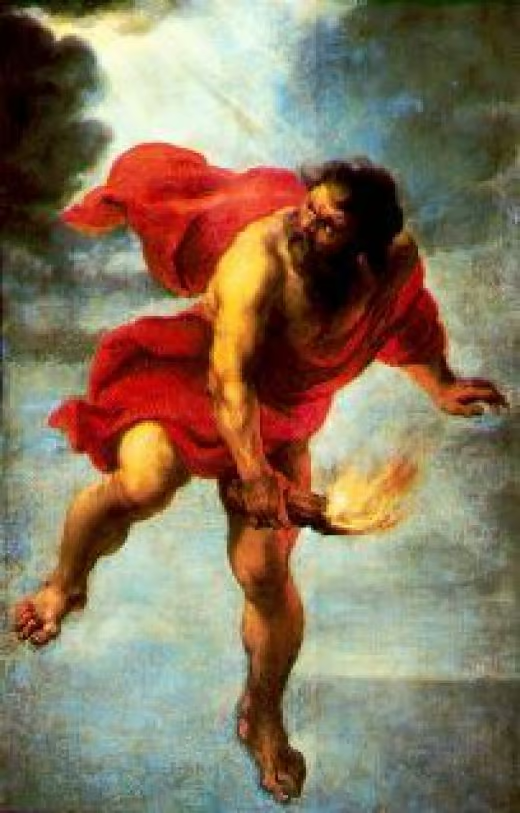
Prometheus is the archetypal ‘over-reacher’, in the mold of Lucifer, one who seeks and obtains great power, only to be consumed and destroyed by it. In the Greek myth Prometheus tricked Zeus in a misguided effort to challenge him, which resulted in an angry Zeus with-holding fire from humanity. Prometheus then ‘stole fire’ from Olympus and gave it back to humanity, which enraged Zeus further. He responded by sending Pandora, the ‘first woman’, to wreck havoc on humanity as retaliation. Pandora was alleged to have been created from clay (much how the Sumerian goddess Ninhursag was believed to have created human beings from clay). Later myths have Prometheus himself fashioning the human race out of clay. Prometheus is considered a champion of humanity, but also a trickster figure who is ultimately something of a mixed blessing.
Shelley himself was involved in the writing of his renowned play, Prometheus Unbound (published in 1820) around the same time that his wife was writing Frankenstein. For Percy Shelley, Prometheus was more hero than trickster. In his play Shelley reworked the Greek myth, and had Prometheus overcome Zeus, symbolizing the victory of intelligence and human creativity over heavy-handed institution and tyranny (as represented by Zeus). The Romantic poets—Shelley, Keats, Byron, Blake, Wordsworth, Coleridge, etc.—exalted the idea of the rebel who opposed the rigid and passionless ideals of the Age of Reason and its spawn, the Industrial Revolution.
There are important connections between Prometheus, Satan of Milton’s Paradise Lost, and Frankenstein. Mary Shelley, as with her husband and other key Romantic poets of the time (such as William Blake) accorded great importance to the figure of Satan in Milton’s epic poem (published in 1667). Milton’s Satan was originally Lucifer, most dazzling of the archangels, but jealous of his cosmic brother Christ. Lucifer launched a rebellion against God and the hosts of Heaven, which ended in dismal failure and landed him in Hell, transformed into Satan (the word is Hebrew for ‘adversary’). Here he begins his work of ‘tempting’ and misguiding humanity (initially as the Serpent in Genesis).
Some critics have advanced the idea that Dr. Frankenstein corresponds closely to Lucifer—a true rebel seeking to establish his own utterly unique identity via his radical experiments and creation—and that the monster is an analogue of Satan. The transformation from beauty to ugliness was described by Shelley giving voice to Victor as he beheld his hideous creation:
I had worked hard for nearly two years, for the sole purpose of infusing life into an inanimate body…but now that I had finished, the beauty of the dream vanished, and breathless horror and disgust filled my heart.21
In one respect, this passage is the most important in the book, for reasons we will now delve into.
A central understanding of Frankenstein is that the monster and its creator are two elements of the same self. Some earlier literary critics observed that the subtitle of the book—the Modern Prometheus—underscores the essential split in Man (a split that, according to critic Harold Bloom, was very evident in Shelley’s husband Percy Shelley and Lord Byron, her two greatest influences).22
What is the nature of this ‘split’? Many critics who mention it (including the famed Bloom) do not really explain it precisely. Vague allusions are made rather to the dual nature of Prometheus (who, like the Trickster figure, is both helpful and a hindrance—retrieving fire from Olympus to aid humanity, but pissing off Zeus in the process who then vengefully brings more suffering to humanity). Sometimes the ‘split’ is grossly simplified as between that of the ‘head’ and the ‘heart’. But these skirt around the main issue, which is the split between spirit and matter, and more specifically, the division between consciousness and perception.
Dr. Frankenstein rejects the creature that he has created for what is, in truth, a rather ignoble reason: because the creature is ugly. Or, more to the point, because he perceives the creature as ugly—‘breathless horror and disgust filled my heart’.
Mystics throughout the centuries have recognized that attachment to sensory perceptions is the great distraction that keeps us chasing rainbows in material reality, keeps us busy engaged in an interminable game that always has the same overall result: we remain oblivious to our higher spiritual potential. What is this higher spiritual potential? What most wisdom traditions agree on is that it boils down to the direct recognition of our inmost nature as pure consciousness.
The power of sensory perceptions is that they have the ability, in conjunction with our mental processes, to ‘construct’ a reality in which we come to believe that our nature is separate, discrete, and fully and utterly contained within, and limited to, physical form. In short, we come to believe that we are nothing more than our body. If we believe that about ourselves, it is natural to believe that about others. If Victor flees his creature because he visually perceives him as hideous, it can only be because Victor automatically believes that the creature is intrinsically hideous. After all, how could this monster be anything other than his grotesque outer form?
That may seem obvious within the context of a horror story, or even within a story of science (or magic) gone bad, but the more subtle point is that we are all engaged in the process of ‘making real’ our perceptions of reality to the point that we lose all awareness of the one who is perceiving. Much as a movie-goer sits awestruck or lost in the movie they watch, marginally (if at all) conscious of themselves as watcher, so too we lose ourselves in the contents of our life, rarely aware of our actual nature as the consciousness that is witnessing all this—much how we lose all awareness of ourselves as dreamer at night, lost completely in the ‘reality’ of the dream content.
The Egyptian Mysteries and the Second Death
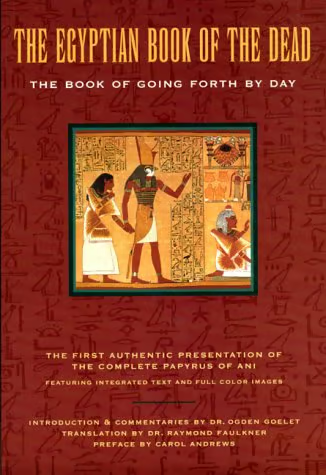
An idea that crops up in many esoteric teachings is the idea of the ‘second death’. This is connected to the view that a human is essentially a threefold structure: body (matter), soul (personality, essentially), and spirit (pure consciousness). When a person dies, their material body decomposes and is dispersed. Their subtler aspect (mind and spirit) then enters a type of ‘in-between’ dimension referred to in different ways—the Pyramid Texts of ancient Egypt (from which derived The Egyptian Book of the Dead) called it the ‘realm of Osiris’; Plutarch of 1st century C.E. Greece designated it as the domain of the Moon (or ‘sublunary’); in Christian tradition it is ‘purgatory’; in The Tibetan Book of the Dead it is called the bardo (which literally means ‘intermediate state’), and so forth. What most of these traditions agree on is that a person who has shed their physical body spends a period of time in this ‘in-between’ dimension undergoing various forms of purification (though according to Tibetan Buddhism, this really amounts to an elaborate dream-world in which we experience the momentum of our habits and various delusions). The ‘second death’ occurs when our time in this in-between realm is complete, and we pass on to the higher realms, which are sometime connected to the ideas of the ‘Celestial’ or the Sun. (Some of these traditions have the essence of the person reincarnating into a new body on Earth without ever passing on to the ‘higher’ realms).
The idea behind initiation, or work on self, or creation of the Body of Light, and so on, is ultimately connected to the idea of experiencing the ‘second death’ in advance, on Earth, before our physical body has expired. In so doing, the person can pass with greater ease through the intermediate realm after the death of the physical body, and so proceed to the Celestial realms of unobstructed consciousness, light, and freedom, bypassing needless suffering and struggle.
The ancient Egyptians in particular provided a comprehensive model of the soul of a person, viewing it as comprised of nine important aspects. These were called the khat (body), ku (reason), khaibit (shadow), ab (heart), ba (soul), ka (double), sab (spiritual body), ren (name), and sekhem (vital force).23 In the context of this chapter, of greatest importance here is the ka, or double. In much of literature the ‘double’ represents a split-off part of a person, often little more than a characterization of Jung’s ‘shadow self’, which embodies the denied and repressed elements of the individual’s personality. In the esoteric wisdom traditions the ‘double’ points toward a higher ideal, that of the ‘guardian angel’, which is ultimately understood to be the higher self of the person.
The Egyptians often depicted the ka as a second image of a king, hence the connection with it as a ‘double’. According to myth, the ka of a person was breathed into them at birth, instilling their body with life and consciousness. (Compare that to the Biblical God who breathes life into Adam). The process of spiritual awakening may be likened to re-identifying with our inner reality, which is pure spirit, or pure formless consciousness.
What obstructs this process is identification with matter (form). Dr. Frankenstein and his monster have been thought to represent many things: everything from aggressive science minus a conscience, to the inner division—the Jekyll and Hyde split of the mad scientist and his creation—within a human being. In terms of esoteric teachings, however, they are good symbols of the resulting ruin and suffering that arises from ignorance of our inner spiritual nature. Victor Frankenstein sought to engineer a creation for his own purposes, but it was a material creation animated with electrical force, a poor copy of the process of spiritual creation that unfolds within us as we set our intention to realize our higher nature. His repugnance with the form of his own creation caused him to reject it. This rejection in turn triggered a series of destructive events that led to everyone’s demise. It’s all a powerful metaphor for what happens when we lose ourselves in concrete material form, oblivious to the subtle, the deep, and the higher. What Victor did to his creature, and his creature in turn did to others, is what we do to ourselves and our world when we fail to look beyond the surfaces of self, other, and universe—in short, when we fail to look beyond appearances, in so doing failing to transcend mere perception.
Notes
- Mary Shelley, Frankenstein: or, The Modern Prometheus (London: Penguin Classics, 1985), pp. 47-48.
- Ibid., p. 60.
- Nevill Drury, Stealing Fire from Heaven: The Rise of Modern Western Magic (New York: Oxford University Press, 2011), p. 3.
- Shelley, Frankenstein, pp. 57-58.
- Ibid., p. 62.
- Ibid., p. 87.
- Ibid., p. 88.
- Ibid., p. 89.
- Ibid., p. 90.
- Ibid., p. 95.
- Ibid., p. 96.
- Ibid., p. 97.
- Joscelyn Godwin, The Golden Thread: The Ageless Wisdom of the Western Mystery Traditions (Wheaton: Quest Books, 2007), p. 68.
- www.etymonline.com/index.php, accessed June 20, 2011.
- Martin Tropp, Mary Shelley’s Monster: The Story of Frankenstein (Boston: Houghton Mifflin, 1976), p. 56.
- Gershom Scholem, Kabbalah (New York: Meridian, 1978), p. 353.
- Ibid., p. 352.
- The BFI Companion to Horror, edited by Kim Newman (London: Cassell, 1996), p. 122.
- Dolores Ashcroft-Nowicki, The Ritual Magic Workbook: A Practical Course in Self-Initiation (New York: Red Wheel/Weiser, 1998), p. 153.
- http://articles.cnn.com/1999-11-16/entertainment/9911_16_natl.film.registry_1_film-registry-national-film-preservation-act-lists-of-favorite-films?_s=PM:SHOWBIZ (accessed June 20, 2011).
- Shelley, Frankenstein, p. 105.
- Harold Bloom, Bloom’s Modern Critical Views: Mary Shelley (Philadelphia: Chelsea House Publishers, 1985), p. 2.
- There is not always a general consensus among Egyptology scholars about the precise meanings of these terms. I am here following Arthur Versluis, generally recognized as one of the more eminent scholars in this field. See Arthur Versluis, The Egyptian Mysteries (New York: Arkana, 1988), pp. 52-53.
Copyright, P.T. Mistlberger, 2011, All Rights Reserved.