
Star-Crossed Lovers and Families at War
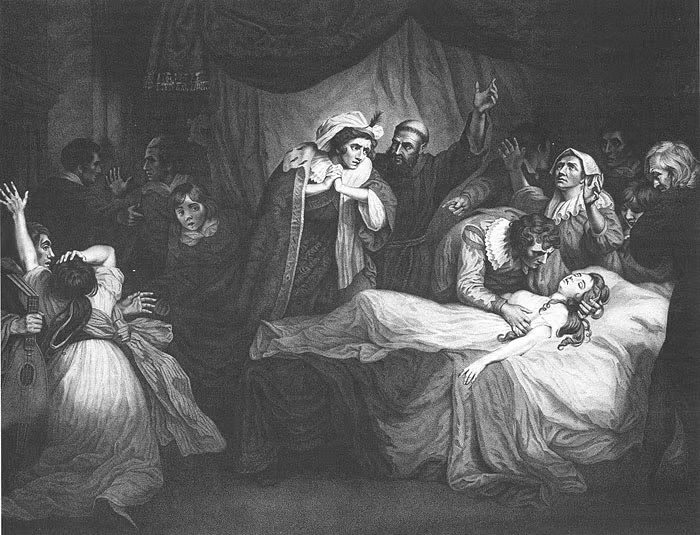
Two households, both alike in dignity,
In fair Verona, where we lay our scene,
From ancient grudge break to new mutiny,
Where civil blood makes civil hands unclean.
From forth the fatal loins of these two foes
A pair of star-cross’d lovers take their life…—Romeo and Juliet (Prologue)
Background
The notion of the ‘star-crossed’ lovers is ancient and archetypal. It refers to a love relationship that is doomed from the beginning, predestined to tragedy, having an ending that is as fixed as the motions of the stars above. On one level the term ‘star-crossed’ alludes to astrology, an ancient art first practiced in Babylon over three thousand years ago (and possibly earlier in Sumeria), based largely on the premise that the positions of the stars overhead (which includes, in this sense, the planets) has a direct bearing on earthly events, and on an individual’s fate. As in the Hermetic maxim, as above, so below, the heavens were thought by the ancients to directly reflect and influence the affairs of men and women.
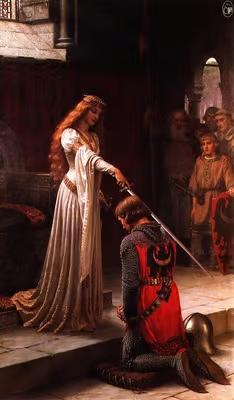
Shakespeare’s version of the fable of the star-crossed lovers is the most renowned—so much so that over four centuries later his young lovers remain cultural icons, quintessential symbols of both the longing heart and of a love fated to end in tragedy.1 But his rendition of the doomed lovers-theme is certainly not the oldest in world literature. The Arthurian romantic legend of Lancelot and Guinevere predates it by around four hundred years, first appearing in the poem Lancelot: The Knight of the Cart, written by the French poet Chretien de Troyes, around 1180 C.E. The legends of King Arthur and Guinevere—or ‘Gwenhwyfar’ as her original Celtic name was spelt—did not originate with Chretien de Troyes, but rather with the largely fictive efforts of earlier writers such as Geoffrey of Monmouth, especially via his History of the Kings of Britain (1136) and William of Malmesbury’s Acts of the Kings of England (1125). But it was Chretien de Troyes who first popularized the story of the doomed triangle of love between Arthur, Guinevere, and Lancelot.
Standing behind the Lancelot-Guinevere legend (and an influence on Chretien) were even older Celtic/Irish tales of love that often involved a woman who was actually originating from a non-human dimension (such as ‘fairies’) incarnating as a human mortal, marrying a human male (sometimes a king), and eventually being reclaimed by her non-human (‘fairy’) husband.2 This theme was partially echoed in J.R.R. Tolkien’s 20th century fantasy The Lord of the Rings, where the female ‘Elf’ Arwen, an immortal, falls in love with a mortal human king (Aragon). Other Celtic variations of this involved the wife of an important man (such as a king or other lord) being abducted by another man and taken to some mysterious alternate world or dimension, eventually to be rescued by her husband. These themes were reflected in Lancelot and Guinevere, particularly the motif of the ‘outsider’ breaching a marriage or other ‘forbidden’ arrangement in the name of unbridled passion.
The idea of ‘courtly love’ embodied in the Lancelot myth was based on the ideal of ‘special love’, a term that in current times we take for granted, if only because it has become such a fixture of popular culture (the number of songs, poems, films, and paintings dedicated to romantic or ‘special love’ are by now almost uncountable). However, courtly or romantic love, especially involving characters who consummate their passion, is a relatively recent ideal in history, findings its origins with the 12th century troubadours, particularly William IX, the duke of Aquitaine (1071-1127), who is recognized as composing the first troubadour love songs.3 Chretien de Troyes, in his Lancelot: The Knight of the Cart, expressed the typical passion and longing of this sort of love, in a scene where Lancelot and Guinevere are conversing at night in a clandestine fashion, through a window separated by iron bars:
Lancelot boasted with some pride
if the queen wanted him inside,
she should not have the slightest doubt:
no iron bars could keep him out…
‘My lady, to be where you are,
I would not heed an iron bar.
All that can keep me out is you;
no entry then would I pursue.
If you allow me to come near,
the way to you is wholly clear,
and yet, if you do not consent,
that is such an impediment,
there is no way that I would proceed.’ 4
This sort of courtly passion from the strong, handsome, and fearless warrior-knight was found to be irresistible to the queen, and she relented. He broke through the bars (wounding his hands in the process), and made love to her, only to have to slip away in the morning before he was discovered in bed with the king’s wife. Inevitably of course, their romance was discovered, with disastrous consequences for all parties.
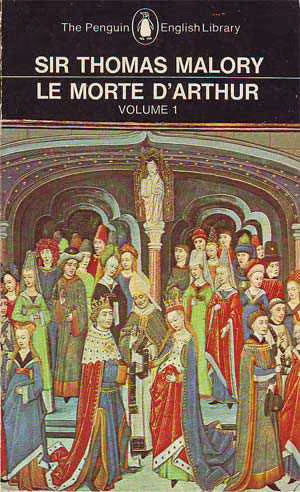
The story of Chretien de Troyes’ star-crossed lovers Lancelot and Guinevere was developed further by later authors, most notably by the English novelist Thomas Malory who in 1485 published his Le Morte d’Arthur (the book that became the main source for much of the modern world’s beliefs about King Arthur, Queen Guinevere, the twelve knights, and the quest for the Holy Grail). In addition to the Celtic/Irish precedents that Chretien drew from, he also had standing behind him the tale of Tristan and Isolde (by the poets Thomas of Britain and Beroul of Normandy). This was an earlier 12th century French work that involved a love triangle between an English knight (Tristan), an Irish princess (Isolde), and King Mark of Cornwall, who is Tristan’s uncle. In one of the versions of the tale, Tristan defeats an Irish knight in battle, and then takes the Irish princess to southwestern England so that his uncle (King Mark) can marry her. Along the way, Tristan and Isolde drink a magic potion that causes them to become deeply infatuated with each other. Isolde ends up marrying Mark, but carries on a clandestine and adulterous affair with Tristan. Eventually King Mark finds out, and decides to punish Tristan with death and Isolde by sending her to a leper colony. Tristan however thwarts his would-be executioners, escapes, rescues Isolde, and the two take hiding in a forest. They are eventually found by Mark, but this time he decides not to punish them, coming to an agreement instead in which Tristan will go to France and Isolde will stay with Mark. Once in France, Tristan marries another woman also named Isolde.
The common theme in these tales involves not just triangles and passionate adultery, but also a challenge to the whole institution of marriage, and in particular, arranged marriage. It was this theme that was echoed most strongly in Romeo and Juliet. Written about a hundred years after Malory’s Le Morte d’Arthur, it was first published in completed form in 1599 (though written a few years before, when Shakespeare was around 30). The play however does not draw on Malory or Chretien for inspiration; it rather borrowed from earlier 16th century Italian love fables, especially Arthur Brooke’s poem The Tragical Historie of Romeo and Juliet, first published in 1562 (Brooke himself said he was drawing from an older, unpublished poem based on these characters). Other influences stretched back at least fifteen centuries, to a 2nd century C.E. work called Anthia and Habrocomes, by the Greek author Xenophon, as well as portions of Ovid’s Metamorphosis (written in Rome shortly after the birth of Christ). All of these stories dealt with recurrent themes of idealized, romantic love vs. arranged marriage, conflicting would-be in-laws, untimely deaths, and ‘false deaths’ brought about by potions.5
Shakespeare used Brooke’s poem, and other sources, as a framework, but he greatly developed the story, adding new characters and injecting his own incomparable mastery of language and psychological and philosophic insight. Although most literary critics agree that Romeo and Juliet is not one of his more mature or philosophically complex works—his dramatic masterworks such as Hamlet, Othello, King Lear, and Macbeth were yet to come—it is agreed that the reason Romeo and Juliet has remained his most popular work is not just because of the love story. The play contains rich insights on the ‘religion of love’, especially as delivered by the character of Juliet, all the more remarkable as she ‘hath not seen the change of fourteen years’—that is, she is a girl of thirteen.
The Story
To briefly summarize the plot: the story takes place in Verona, a town in northern Italy. At the center of the story are two families, the Montagues and the Capulets, who are hostile to each other, and have been for some time. (Romeo is a Montague, and Juliet is a Capulet). The play wastes no time in showing this conflict: after the brief prologue, a street fight ensues between some men of the rival clans. The Prince of Verona breaks up the fight with stern warnings to both sides about further breaches of the peace. This is then followed by Romeo’s cousin, Benvolio, telling Romeo’s mother, Lady Montague, about Romeo’s depression. Romeo is unhappy because he is in love with Rosaline, a young woman from the rival Capulet clan, but the love is not returned. (Rosaline has no actual lines in the play, being an ‘unseen’ character). At the behest of Benvolio and Mercutio (the latter a close friend of Romeo, and a character who is given some of the play’s wittiest lines), Romeo attends a ball at which a number of beautiful young women will be present, including Rosaline. While at this ball, looking for Rosaline, Romeo catches his first glimpse of Juliet. The two are smitten with each other. When Romeo first lays eyes on her, he says,
Did my heart love till now? Forswear it, sight.
For I ne’er saw true beauty till this night.
He then approaches her; the energy between them is electric. After some brief witty banter between the two of them, Romeo speaks of his desire to kiss her (in some adaptations of the play, Romeo does kiss her at this point). Juliet is then called away by her mother, at which point Romeo realizes that she is a Capulet (the sworn enemies of his family). He laments that he is now in love with the ‘enemy’. Juliet then finds out the same, that Romeo is the only son of her family’s enemy. She remarks,
My only love sprung from my only hate,
Too early seen unknown, and known too late.
Prodigious birth of love it is to me
That I must love a loathed enemy.
The ball ends and the guests leave, but Romeo, heartsick (and having thoroughly forgotten Rosaline), seeks to be near Juliet, and so climbs over her garden wall. His friends Mercutio and Benvolio look for him, to no avail (with Mercutio comically trying to conjure Romeo in a parody of a wizard summoning a spirit he can’t find). This is then followed by the famous scene with the balcony, with Juliet emerging as Romeo, unknown to her, watches her in the garden from below. After rhapsodizing over her beauty, but not feeling the courage to call out to her, he concludes with,
O that I were a glove upon that hand,
That I might touch that cheek!
Juliet, not realizing that Romeo is in the bushes and can hear her, utters some of literature’s most immortal lines, such as,
…Oh be some other name,
What’s in a name? That which we call a rose
By any other word would smell as sweet…
Followed by,
Oh Romeo, Romeo, wherefore art thou, Romeo?
Deny thy father and refuse thy name,
Or if thou wilt not, be but sworn my love,
And I’ll no longer be a Capulet.
Romeo, able to bear it no longer, then reveals himself to Juliet. At first she is startled, and embarrassed, and backtracks a bit on her affections, but this does not last long. Soon she admits to her love for him, cautioning him to not think that she is giving herself to him too easily, but only because he has already heard her private thoughts. After exchanging all sorts of lover’s sweet nothings (although in Shakespeare’s language, they are anything but ‘nothings’), they agree to marriage, and then Juliet goes back into her house and Romeo leaves.
When dawn breaks, Romeo pays a visit to Friar Lawrence, a Franciscan monk, to confess what has happened and to request that the Friar marry him and Juliet. The Friar is at first shocked, and then kids Romeo for having so recently loved another woman (Rosaline); but he agrees to marry him and Juliet, seeing it as a good opportunity to heal a rift between their warring families.
Romeo then meets up with his buddies Mercutio and Benvolio, and exchanges a series of remarkable witticisms with Mercutio. Although normally Mercutio is the sharper wit, on this occasion Romeo at least matches him, because he is a man in love and so is firing on all cylinders. (Mercutio, like Falstaff or Bottom, is one of Shakespeare’s most memorable characters. There was a long repeated rumor that Shakespeare decided he had to kill off Mercutio later in the play, before Mercutio himself ruined the play with his cutting witticisms and endless satire). Shortly after, he conveys a message via Juliet’s nurse, to meet him at Friar Lawrence’s cell so that they can be married.
Violent conflict then enters the play. Juliet’s cousin Tybalt, offended that Romeo had snuck into a Capulet ball, challenges Romeo to a duel, which the latter refuses on account of the fact that his marriage to Juliet now makes him kin to Tybalt. Mercutio, outraged by both Tybalt’s audacity and Romeo’s refusal to fight—mistaking it for cowardice because he is unaware that Romeo has married Juliet in secret—decides to fight Tybalt himself. Romeo attempts to intervene, and while doing so, Tybalt uses him as a shield to stab Mercutio. As Mercutio lies dying, he continues to be dryly witty, but blames Romeo for intervening in the fight in such a way that allowed Tybalt to mortally wound him. Romeo than admits that his love for Juliet has softened him in a way that has not turned out well:
…O sweet Juliet,
Thy beauty hath made me effeminate
And in my temper softened valour’s steel.
Mercutio then dies. At that moment Tybalt, who had run off, returns. Romeo exchanges harsh words with him; they fight, and Romeo kills him. Convinced by Benvolio to flee, Romeo does so, at which point others show up, including Montague, Lady Capulet, and the Prince. Montague defends Romeo, saying his actions were justified, but the Prince banishes him from Verona, warning that if he is caught he will be executed.
The next scene finds Juliet’s bumbling nurse trying to tell Juliet about the death of Tybalt, but initially making it sound as if Romeo is dead. Eventually she gets her words out clearly, and informs Juliet that Romeo has killed Tybalt. At first Juliet is shocked, and utters some lines that memorably evoke the imagery of the angel/devil dichotomy that she momentarily perceives in Romeo:
O serpent heart, hid with a flowering face!
Did ever dragon keep so fair a cave?
Beautiful tyrant! fiend angelical!
Dove-feather’d raven! wolvish-ravening lamb!
Despised substance of divinest show!
Just opposite to what thou justly seem’st,
A damned saint, an honourable villain!
O nature, what hadst thou to do in hell,
When thou didst bower the spirit of a fiend
In moral paradise of such sweet flesh?
Was ever book containing such vile matter
So fairly bound? O that deceit should dwell
In such a gorgeous palace!
After Juliet’s nurse complains about men in general and adds ‘Shame come to Romeo’, Juliet then comes back to herself, and becomes fiercely protective of Romeo, realizing that he probably killed Tybalt for just cause, remarking, ‘And Tybalt’s dead, that would have slain my husband’.
The scene shifts to Friar Lawrence’s cell, where he informs Romeo that the official verdict for his having slain Tybalt is banishment. Romeo laments that this is a fate worse than death, because he will be separated forever from Juliet and alive to know it. The scene shifts again, this time to the house of Capulet (Juliet’s father), where he agrees to marry his daughter to Count Paris, a young nobleman who has long loved her.
Romeo then furtively visits Juliet in her chamber, where they make love for the first (and last) time. As the morning comes, they part company in anguish. Juliet’s mother, Lady Capulet, then arrives, and mistakes Juliet’s grief as due to the loss of her cousin Tybalt. She then informs Juliet of her intention to have the ‘murderer’ Romeo poisoned. Juliet feigns agreement. Lady Capulet then tells Juliet about her father’s arrangement that Juliet will marry Count Paris the following week. Juliet protests angrily, at which point her father enters; seeing her distraught mix of emotions, he is at first baffled. As she protests the arrangement to marry Paris, her father grows angry, calling her things such as a ‘green-sickness carrion’, ‘tallow-face’, ‘disobedient wretch’, and ‘whining mammat’.6 He then threatens to physically drag her to the wedding. The nurse and Juliet’s mother protest his rough language to Juliet, but he responds with the typical father’s lament, that he has worked hard his whole life, has finally found his daughter a fine husband, that she is ungrateful, etc. He then ends his outburst by threatening to banish his daughter to the streets if she rejects Paris.
All this is then followed by the scenes for which the play is famous (in addition to the earlier balcony scene). Juliet, with no interest in marrying Paris, seeks out Friar Lawrence’s help. After telling him that she will kill herself rather than marry Paris, the friar then offers a plan: she is to drink a special potion that will cause her to seem to be dead for forty-two hours, enough time to avoid her marriage to Paris. During that time, not only will she avoid the marriage, but her family, thinking her dead, will entomb her in the family crypt. Romeo is then to come and retrieve her, and the two can escape together. Friar Lawrence agrees to inform Romeo of the plan via a messenger. Juliet, without hesitating, agrees to the plan. Juliet returns to her house, and the night before the wedding, she takes the potion, which works. The next morning she is discovered by her nurse, and then her parents; all three wail and lament Juliet’s apparent death. At the friar’s behest, the family shifts the wedding to a funeral.
However the friar’s plan has gone astray; the letter he sent to Romeo, informing him of the plan—the potion, the false death, and his need to fetch his wife when she awakes in the family crypt—never arrived. Romeo’s servant Balthazar, hearing of Juliet’s apparent death, finds Romeo and informs him of the grim news. Romeo is of course devastated. He then buys some poison, and takes it with him to the crypt where Juliet lies. Count Paris is there, grieving over his ‘dead’ fiancée; upon seeing Romeo, Paris is outraged, and challenges him to a fight. Romeo slays him. (Paris, of course knew nothing of Romeo’s marriage to Juliet, only knowing him as the man who had killed Tybalt).
Romeo then mourns the death that surrounds him: Paris, and Tybalt (whose body is also in the crypt), and last but not least, his beloved Juliet (whom he still thinks is dead). He says,
…O, here
Will I set up my everlasting rest,
And shake the yoke of inauspicious stars
From this world-wearied flesh. Eyes, look your last!
Arms, take your last embrace! and, lips, O you
The doors of breath, seal with a righteous kiss
A dateless bargain to engrossing death!
He then drinks the poison and dies. Friar Lawrence enters the crypt, and finds Romeo and Paris both dead. At that moment, Juliet awakens from her drug-induced coma. The friar, telling her what has happened, tries to get her to join him in a convent, but she refuses. As the constables are coming, the friar hastily leaves. Juliet then takes Romeo’s dagger, and in despair, kills herself.
The concluding scene has the two families convening in the crypt amongst all the death. The friar recounts the true story to them of what happened, including, most importantly, the secret marriage of Romeo and Juliet, which none of them knew about. Montague and Capulet, the fathers of Romeo and Juliet, agree to end their hostility, and to symbolize this both agree to build a gold statue of each other’s child, to commemorate their spirits. The Prince of Verona has the last lines:
A glooming peace this morning with it brings;
The sun, for sorrow, will not show his head:
Go hence, to have more talk of these sad things;
Some shall be pardon’d, and some punished:
For never was a story of more woe
Than this of Juliet and her Romeo.
Commentary
All Shakespeare’s plays involve a certain need on the part of the audience to suspend disbelief. I recently watched the 1954 Hollywood version of Romeo and Juliet (with Lawrence Harvey and Susan Shentall in the leads) which although lavishly made, does require at times an effort to keep a straight face, if only because of the intensely effeminate quality of the men, dressed in ornate costumes, prancing around with stage swords, all the while spouting Shakespeare’s exquisitely complex Elizabethan English poetry. It is as far from realism as a modern science fiction film is from modern street life. People simply don’t talk like that.
And yet that is precisely Shakespeare’s power, much as it is the power of John’s Gospel to convey the ‘cosmic Christ’, a figure far beyond the wandering Jewish sage of the earlier Gospels. Shakespeare is not just an artist, he is a teacher, a conveyer of wisdom-teachings, and his characters are not regular people, they are instruments through which his transcendent music is played for us to hear.
It has been remarked more than once that romance generally lends itself better to comedy (as in the Hollywood fixture ‘the romantic comedy’), rather than to tragedy. And romantic comedy need not be forgettable ‘fluff’; Shakespeare’s A Midsummer Night’s Dream (written around the same time as Romeo and Juliet) is testament to that. But what makes those two iconic lovers, Romeo and Juliet, so memorable is the brief, bittersweet nature of their passion, like a flash of lightening through a dark night, illuminating a wondrous landscape, only to be shrouded quickly by impenetrable gloom and darkness.
That said the central ‘spiritual’ theme of the story is the healing that takes place at the end, between the two warring noble families. What brings it about is the love of two young people. Juliet is a child of thirteen, which in current times might seem bizarrely young; however in earlier centuries the average person lived only forty or fifty years (old age being a relative rarity), and children in general grew up faster (with Italian girls in particular rumored to mature fast).7 The love of these two adolescents epitomizes the ‘special, romantic love’ referred to at the beginning of this essay. It is, of course, easy to be cynical about such love, but the truth is it is the only type of love most know. It may seem to be the hallmark of youth, but most older adults never truly grow out of it; if they appear to ‘grow out of it’ it is more commonly a case of just giving up on love altogether and learning to cope and survive in relationship (or not, as the case may be). As the literary critic Harold Goddard once put it,
Cynics are fond of saying that if Romeo and Juliet had lived their love would not have ‘lasted’. Of course it wouldn’t—in the cynic’s sense. You can no more ask such love to last than you can ask April to last, or an apple blossom. Yet April and apple blossoms do last and have results that bear no resemblance to what they come from—results such as apples and October—and so does such love.8
Those sentiments are to the point. It is something of a commonplace view, in wisdom teachings, to regard romantic love as merely delusory, as doomed to failure, as fashioned and maintained largely by hormonal biochemistry, and thus largely a case of a person ‘falling in love’ with their own body chemistry response, rather than with the actual other person. And there is of course truth to that. The central idea of wisdom teachings is that fixation on one other person as a source of fulfillment—you complete me—is counter to the deeper reality that we have an ‘inner’ source of fulfillment that if we turn toward, can yield the maturity that helps us to be in relationship with the world around us, not just with one other personality and body. The main point of this view is that fixation on one other person places a tremendous burden on them, with the only possibility being a type of unspoken contract in which both sides agree to exclusively give their attention and energy to each other, in so doing making themselves largely unavailable to the world around them. If one or both ‘break’ this contract, then a heavy price is generally paid, as the one ‘betrayed’ is suddenly made aware of just how dependent they have become on the other.
In this view, ‘special, romantic love’ is an enemy to higher truth because it is based on a fundamental lie, that being that we have no inner source, and thus literally need the ‘special love’ to survive, let alone to experience any sense of fulfillment. If the special love is removed, or worse, betrays us, then we become acutely aware of the skeleton in our closet we have been attempting to avoid facing our whole lives—that is, of just how empty we actually are on the inside. More troublesome, in that place of pain it seems undeniable to us that the inner ‘sense’ of fulfillment we had before was itself created by the other person. This makes their loss all the more unbearable. It is this essential delusion that makes more people commit atrocities (whether against others, or against themselves) in the name of ‘love’ than in the name of any other ideal (with the possible exception of freedom—although that is more a collective, revolutionary issue, rather than an individual, interpersonal one).
All this holds truth, however there is a key point that many who communicate such ideas from the wisdom traditions often overlook, and it is this: in order to grow beyond something, we first have to know the terrain, so to speak. That is, we are going to have some difficulty realizing a universal, transpersonal love if we have not first felt and lived, to some extent, a very grounded and personal love. As Goddard wrote, April will not remain April, but will become October—but not until we have first lived through April.
Shakespeare’s most transcendent character in Romeo and Juliet is Juliet herself, she being given lines in which her thirteen year old virginal personality is rendered an oracle of poetic wisdom, a reincarnation of Aphrodite (or more to the point, the inner genius or higher nature of Aphrodite). These lines spoken by Juliet—often quoted—are a timeless echo of wisdom:
My bounty is as boundless as the sea,
My love as deep: The more I give to thee
The more I have, for both are infinite.
Harold Bloom called the passage a ‘transcendently persuasive utterance of love’s reality, as rich as literature affords…’9 It is certainly that, and more: it stands at the very threshold of non-duality. Juliet’s urge to give unconditionally reflects the universal law of love, which is that it teaches us about infinite abundance, and yields such abundance to us—but only if we exercise it. More, it holds the keys to the gates of full inner illumination, and the realization that there is, ultimately, no-thing to love, because nothing is truly separate.
To embody non-duality is a tall order, however. To recognize the infinite unity of existence is one thing, to live it out in the gritty details of our life is entirely another. That is because our very forms—our bodies, our identities, our creative energies—cry out for expression and the impulse to share with others. Such a sharing is perhaps neither duality, nor non-duality, but simply what is, what remains when we live fully and love deeply, in a way that is free of manipulation and agenda. Arguably this ‘love’ is no longer love, but simply compassion.
The theme of much of historical romance—whether of Romeo and Juliet, or Lancelot and Guinevere, or Tristan and Isolde—is transcending arranged marriage by both knowing and following one’s heart. That this ‘heart’ is a mix of hormone, eroticized fantasy (such as wild attraction to the distant, dangerous, or unavailable lover, which is perhaps in some cases a deeply repressed fantasy of incestual longing), or even an Adam and Eve-type of rebellion against authority, is a given. Yet in a developmental framework, it can be seen as a necessary stage in the maturation of the heart and spirit. If arranged marriage is akin to a childhood in which all is fixed for us, in which individuality is muted, blunted, or almost non-existent, then romantic love can be likened to adolescence and youth, in which we get to exercise our personality and our very personal desires and longings in an honest fashion (rather than pretending to be agreeable to what has been put before us). When Juliet rebels angrily against her father’s attempt to arrange her marriage to Count Paris, she is exercising that first step beyond childhood, and not just because she is thirteen, but rather because she is alive, intelligent, and trusts her own individuality enough to stand up to her angry father. Needless to say, many ‘fully grown’ adults never reach such relative maturity of spirit.
There is a third stage, beyond arranged marriage and steamy romance: that of a ‘sacred love’, or a ‘healing love’ that leaves behind the sweet rush of romanticism, and arrives at a mature and manifestly kind acceptance of each other, warts and all. Not to be confused with mere resignation, survival, coping, or using children as buffers to avoid issues (or worse, as vehicles to dump unresolved issues onto), this type of love may be said to correspond to true adulthood. But it does not tend to be reached unless the heart has been allowed to venture into romance to at least some degree. Juliet’s recognition about love, ‘that the more I give to thee, the more I have’, is the time-honored creed of the awakened sage, the Bodhisattva of Buddhist legend who returns to humanity again and again owing to his having found the key to boundless compassion; or to the Jesus who exhorts us to ‘love our enemies’, and in so doing, discover a far greater well of love, infinite in its reach and possibilities.
However our heart does not reach such capacity without first having been broken, cracked open to allow for expansion and ventilation by the wind of spirit. To suffer a ‘broken heart’ need not necessitate venturing down hopeless alley ways, subjecting ourselves to impossible scenarios, or living through fantasy relationships. But it does mean to summon the courage to explore, because the heart, finally, is best likened to an adventure into the unknown, a realm where we have no control, where factors much greater are at play. If we somehow could know the outcome, we would not grow, because we would never be tested. To venture into personal love is to be tested by the fires of uncertainty, to be planted in the soils of insecurity. And yet this is exactly where we grow the most. As Emerson once said, ‘People wish to be settled; only as far as they are unsettled is there any hope for them’. We cannot be truly and wisely settled until we first taste what it is to be unsettled. As Romeo rightly comments about his clever friend Mercutio, ‘He jests at scars that never felt a wound’—that is, Mercutio mocks romantic love with such derision only because he has never really known it.
The key, however, is recognizing when one has had enough of such growing in the soils of insecurity. At that point it becomes possible to give up the quest for the Holy Grail of ‘true love’, to stop living by the mantra of ‘seek but never find’. For although the search may be necessary, valuable, and gloriously fascinating—as in Juliet’s cry on the balcony to Romeo…
Good night, good night! Parting is such sweet sorrow
That I shall say good night till it be morrow.
…it sooner or later loses steam, for it has served our purpose: to make us aware of a far deeper possibility, a love that no longer seeks its fulfillment in an ideal, but rather understands that the ground it has long been seeking is no longer on the horizon, but is the very earth upon which we already stand.
A final comment should be made about the healing between the warring noble families (the Montagues and the Capulets) that takes place at the end of Romeo and Juliet. We don’t know, of course, how profound this healing was, or whether it lasted any reasonable length of time (the play ends at that point, with the Prince of Verona’s mournful adieu to the young star-crossed lovers). But it is a highly significant element of the play, if only because families must indeed use misfortune to grow, else they will simply reinforce negativity and prejudice, passing it down generation after generation. The children of a family represent the ‘crown jewels’, the fruit and flowers of the tree. They are in potential the leading edge, and so their task always lies in growing beyond their ancestors, in venturing into new territory, standing on the shoulders of those before them, so they can see yet further, and accomplish ‘all this and more’. That Romeo and Juliet were members of families that were arch-enemies of each other, and yet loved each other under such a shadow and with such dangerous risk, is potent symbolism pointing toward the need to undue ancient hatred with love. In this case the lovers perished—at least in body—but the family tree reaped the sweetness of the fruit and the fragrance of the flowers.
Notes
- The characters have even entered the world of justice: there is a ‘Romeo and Juliet law’ that relates to statutory rape.
- Tom Peete Cross and William A. Nitze, Lancelot and Guinevere: A Study on the Origins of Courtly Love (Chicago: University of Chicago Press, 1930), pp 57-59.
- Diane Ackerman, A Natural History of Love (New York: Vintage Books, 1995), p. 49.
- Chretien de Troyes, translated by Ruth Harwood Cline, Lancelot: The Knight of the Cart (Athens: University of Georgia Press, 1990), pp. 127-128.
- For a concise summary of the influences behind Shakespeare’s working of Romeo and Juliet, see Frank Kermode’s chapter Introduction to Romeo and Juliet, from Modern Critical Interpretations: William Shakespeare’s Romeo and Juliet, Harold Bloom editor (Philadelphia: Chelsea House Publishers, 2000).
- ‘Mammat’ was a term for ‘cry-baby’.
- Ackerman, A Natural History of Love, p. 72.
- Harold Goddard, Modern Critical Interpretations: William Shakespeare’s Romeo and Juliet, Harold Bloom editor, p. 48.
- Harold Bloom, Ibid., p. 2.
Copyright 2010 by P.T. Mistlberger, all rights reserved.