
Sometime during the 8th or 9th century CE, a great Tantric adept named Padmasambhava made a hazardous journey from India to Tibet. This teacher’s task was enormous, it being no less than the seeding and nurturing of a spiritual tradition, Vajrayana (Tantric) Buddhism, in a hostile land peopled by warring and xenophobic tribes, a tradition that was radically and threateningly different from the Bon shamanism that was indigenous to Tibet at that time.
Of course, nobody likes their territory being suddenly usurped, even most spiritual teachers. And so, when Padmasambhava got to Tibet and went about trying to do his thing, he did not receive a very warm reception, and after refusing to leave, had negative energies unleashed upon him by the Bon sorcerers. At this point the great Tantrica did a very interesting thing: instead of fighting or ‘flighting’, he stood his ground and, legend has it, tamed and ‘converted’ the demons into guardians (Dharmapalas) of the Tantric teachings. The legend further continues that this accomplishment afforded the opportunity for these entities to work off much of their ‘terrible karma’, by utilizing their tremendously powerful energies in the service of something spiritual and constructive.
How did Padmasambhava do it? Esoteric technicalities aside, he must have been an extraordinarily courageous person — one might want to say, fearless. In the Tibetan mythos, he was described as having the ability to manifest different forms, some of which appeared as ferocious, bug-eyed gargoyles, such as Dorje Drolu, in order to “meet fire with fire.” Hence, it was not by any act of saintly sweetness that Padmasambhava was able to tame these Fierce Ones. Rather, he manifested the active, fiery face of Compassion, which is inherently involved and challenging in its expressions.
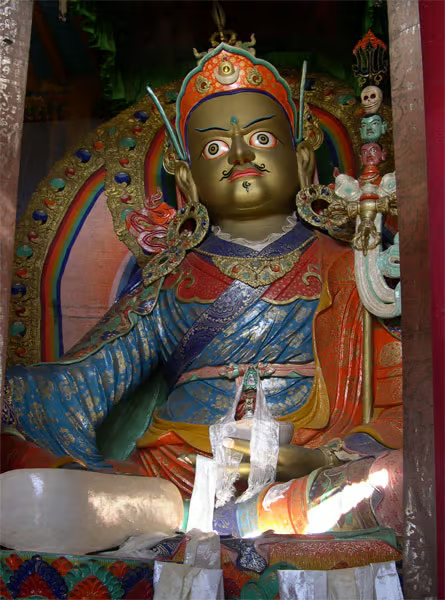
Of course, this still doesn’t answer the question. For “fighting fire with fire,” as we know from our own lives, fails miserably all too often. Rather, all this has to do with the internal process of dealing with negative energy. Padmasambhava could manifest such fiery Compassion only because he had a right relationship with his own dark side — in short, he had integrated it, and thereby transcended it. To get a better handle on what we are talking about here, imagine Jesus for a moment storming into the temple to chase out the moneychangers. Or picture Confucius, fleeing from a meeting with the Taoist master Lao Tzu, claiming dazedly afterwards that “Today I have met a dragon.” Or look for a moment into the flaming eyes of black Kali, a Hindu form of the Goddess, as she dances on the corpse of a being who symbolizes dullness, weakness, and lack of commitment.
In the spiritual domain, it is something of a well known phenomenon that light (consciousness) doesn’t just attract light, it also attracts darkness (unconsciousness). Hence whenever a particularly strong spiritual teacher, who embodies a degree of radical clarity, has shown up somewhere on the planet, or where a community attempting to collectively awaken has blossomed somewhere, it is generally only a matter of time before the apparent ‘forces of darkness’ show up on the scene. These ‘negative energies’ may come in many different guises, but the bottom line is that they usually manifest as some sort of internal breakdown, betrayal, pollution of, or offensive on, the original teachings and/or collective intention. In short, everything ultimately fails, or is a greatly diminished by-product of what it originally set out to become. Historically, one has only to look at endless examples of this: the destruction of Buddhist universities in north India at the turn of the millennium by Islamic hordes; the burning of the famous library of Alexandria; the strange disappearance of possibly advanced Mayan and Egyptian civilizations, for reasons which appear most likely to do with internal corruption; the genocide in Tibet at the hands of communist China, including the intentional destruction of thousands of its monasteries, housing ancient books and priceless art; the burning of thousands of innocent pagans (and non-pagans) during the European Inquisitions; the destruction of advanced Islamic centres of civilization by Mongolian marauders and Christian crusaders; the murders of Christ, Socrates, Mansoor, and so on.
All of this can be looked at from two angles. First, that impermanence is part of the fabric of existence, so why gripe about a few villages turning to sand dunes, some scriptures getting burnt, some artwork being defaced, or a few masters getting crucified? One might even argue that such things had it coming anyway, and that this is a natural way of getting rid of pretentious, dated, dusty, or self-important phenomena. There is doubtless an element of truth to this, in the sense of lightening-generated forest fires clearing the way for new ecological growth. But this line of thinking carried too far begins to lose touch with perspective, let alone compassion.
However, instead of concerning ourselves with the causes behind the fate of spiritual realizers and their communities, a better concern is to look within, and while we’re at it, to take a hard, critical look at the famous new age maxim ‘the perfect thing always happens.’ That is ultimately true, but is usually not understood. We cannot see how ‘the perfect thing is always happening’ until we first see the degree to which we think we can exercise real choice, when in fact, in our typical unconscious, inwardly divided state, we cannot. That is, we must first honestly uncover and expose our cherished illusions.
Herein we enter into the great dilemma: the problem of Free Will. What is typically said is that what makes our souls human is the capacity for choice. This is supposed to be what differentiates us from the angels or other-dimensional intelligences (if we allow, for a moment, that such may exist). The entire ascension of Christ, and its attendant mythology, appears to be based on the incontrovertible power of choice, in that his final statement on the cross, allegedly ‘it is accomplished,’ is testament to the ultimate decision to realize his divine condition (as consciousness attuned with the Infinite). Likewise with Gautama Buddha, his six year ordeal culminating with his awakening under the Bodhi tree, appears to be a series of choices made in the direction of greater and greater insight into the insubstantiality of the ego-self.
Which brings us to the myth of Lucifer, the great “light bearing” Archangel. Several mythologies, most notably those deriving from Persian sources, recognize him as the ultimate symbol of rebelliousness, or disobedience to a supposed all-powerful Prime Creator. He does not want to surrender to the Whole, and thus begins the ordeal of Separation, or the beginning of the misuse of Free Will. And yet, if looked at dispassionately, such a transgression would be a necessary step in the direction of spiritual growth and maturation, in the sense that the perfect Unity of Enlightenment or God-realization cannot be understood or even remotely appreciated without a prior taste of the agony of Separation. Thus, “darkness” is an integral part of the Divine Plan, in the unfolding and blossoming of a universe based on Free Will.
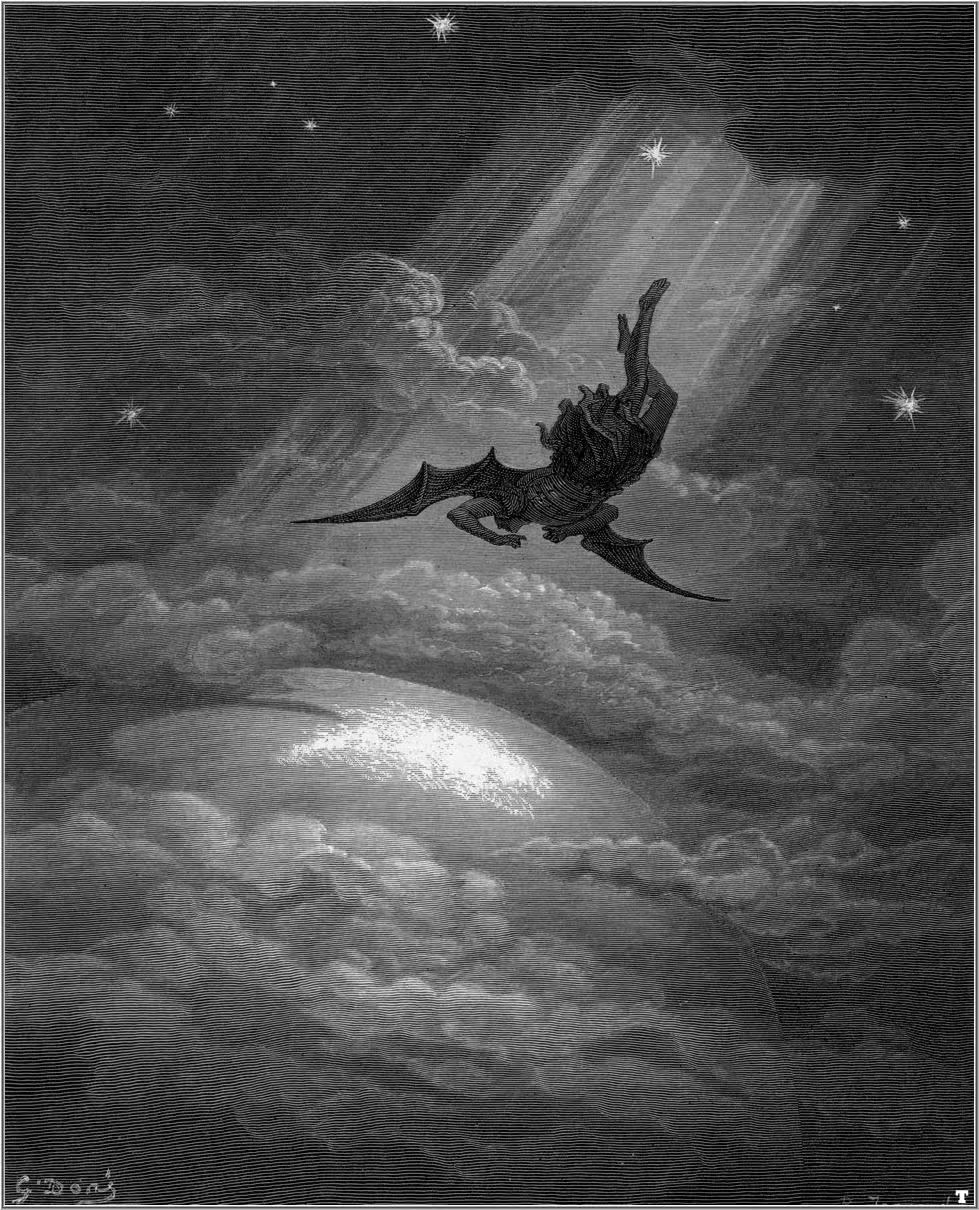
This is why, according to Carl Jung, many of the symbols unearthed in the hermeneutic writings of the old Church Fathers associated with Christ are also associated with Lucifer, such as the lion, snake, raven, eagle, and fish. They are two aspects of the same essential energy, one providing the raw, separating force that ultimately is our greatest tester, the other the correcting principle that returns us to the primal unity of the Source. But neither is defined without the contrast of the other.
From the highest perspectives, the issue of Free Will becomes moot, and is eventually seen to be a non-issue. This is because the deepest Awakenings entail the realization that our “personal will” is already truly at One with the Universal Will of our Source. It is only in our unconscious condition that we perceive and experience our will as Separate from the One Will. Thus, from the context of experiencing ourselves as Separate beings, we must indeed make choices which serve our Awakening — even though as we begin to wake up, it becomes increasingly clear how everything is unfolding as it must, and that our personal will is becoming absorbed into the Will of the Source, just us our personal consciousness is slowly revealed to be already at Home in the consciousness of the Source.
Anyone who has looked at Tibetan Buddhist art (usually in the form of statues and paintings called tangkas) has encountered a starkly dualistic vision: benevolent buddhas, bodhisattvas, and saints, juxtaposed with fierce demons, guardians, and “wrathful emanations.” These latter are actually different aspects of the same entity, demonstrating through symbolic language the importance of going beyond duality by embracing both the light and the dark. For example, the fierce Mahakala, the great black Guardian, is actually the wrathful form of the Bodhisattva of Mercy and Compassion, Chenrezi. They are two different expressions of the same energy. Likewise, Manjushri, the Celestial Buddha of Wisdom, expresses the active face of Wisdom through the fearsome form of Yamantaka, known as the “Slayer of Death.” Both Mahakala and Yamantaka could easily be mistaken for simple demons, and yet they function as powerful, fiery manifestations of Awakened consciousness.
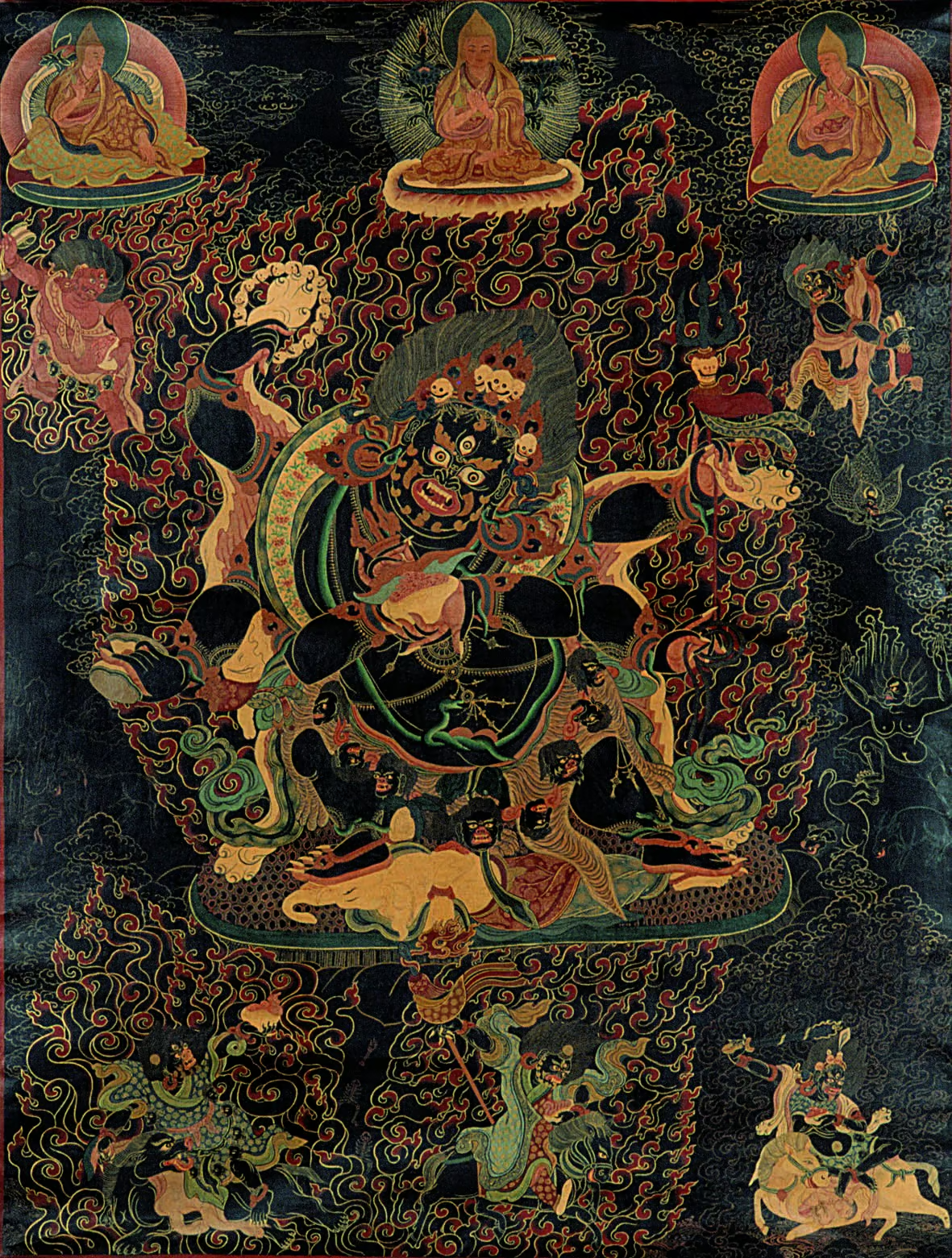
In some forms of Tibetan Buddhism a practitioner may be assigned one of these wrathful entities as a visualization practice, if that person is working on understanding the dark, passionate energy represented by that deity. The end goal is not to change the “bad” into the “good,” but rather to cultivate a profound understanding of what exactly “light” and “dark” are, so that both can be transcended and an Awakened, non-dual consciousness gradually cultivated, yielding the final understanding that it is nothing other than our minds that create “reality,” including the categories of good and bad, positive and negative, light and dark, etc. This represents the wearing down of Projection, that tendency to “disown” the contents of our psyches, and to fear, shun, or loathe that which reminds us of this inner denial.
When we penetrate below the thin veneer of our socialized mask, the face that we usually present to the world and each other, what is generally found underneath is a great deal of darkness; an inchoate mass of conflicting impulses, sado-masochistic secret thoughts, and endless gradations of feelings, from rage to terror, all covering what we can designate the ‘Core Wound’. This is a condition of human existence that is essentially universal, usually just below the threshold of consciousness, and expressing as anxiety, fear, shame, self-doubt, and general resistance to happiness, success, and empowerment. For most, it is a definitive reality, the place where we all experience profound doubt about our worthiness and birthright as alleged divine beings. In that place, it seems astonishing that anyone could truly love us, and any pretense of self-knowledge is seen to be hollow and foolish. At this subterranean depth, it is clear that we “know” virtually nothing.
From such a “ground of being” level so much is possible, in the way of genuine transformation, but the great tragedy is that most people walking some sort of spiritual journey generally stop short of embracing this primal wound, or even really entering into it. It is here where the “Loch Ness monster of Denial” rears its head, convincing us that it is not necessary to face such a woundedness, or even, indeed, whether we are really wounded that much at all. A particularly tricky sort of denial is the spiritualized form, which argues persuasively that, because of all the work we have done on ourselves (and the money spent doing so), we are now beyond such things, although what passes for “beyond” is very often a kind of heady numbness, lacking intensity or creativity.
All paths can and usually do develop their own form of fundamentalism, and the “New Age” has not been spared this problem either. New Age fundamentalism demonstrates (except in rare sectors) a general dislike of the shadow side of human nature, and a tendency to dwell in conceptual systems of thought that afford protection from facing the deeper, dirtier reality of one’s “personal energy system”. Having detailed information about past lives, crystals, aliens, or thought-systems that profess to explain much of our history or current challenges may under certain conditions prove useful and even enriching, but if not combined with an experiential understanding of the workings and movement of our minds and energy, and the sincerity and practicality to actually do something about it, such arcane knowledge is ultimately ineffective in the field of bona fide transformation. It is like endlessly admiring the technical blueprints of a large sailboat, without ever getting down to building it or even, alas, sailing on it.
The investigation of “darkness” tends to naturally liberate strong energies, particularly the sexual force. Many times in my transformational seminars and workshops I have spoken about the association between the Judeo-Christian “devil” and the sexual force, an energy that is referred to in Sanskrit as the “serpent force” (kundalini), owing to its “coiled up” condition at the base of the spine, as perceived by practitioners of Kundalini Yoga, or those with psychic capacity. The connection of this power with the Judeo-Christian “devil” — which is really a somewhat silly caricature of the old pagan “Horned God”, also known as Cernunnos or Baphomet (the ass-headed idol of the medieval Knights Templar) — lies in the fear-based structure gradually implemented by the Church over many centuries. This seems to have had its genesis during the 4th century CE, when sections of the Bible that referred to reincarnation were removed. This is significant because the doctrine of “one life” and eternal damnation were fear-based codifications designed to control the populace effectively.
Likewise, the sexual force was the single greatest threat to the religio-political vise grip exerted by the Church. That is why those who have a deep under-standing of the Tarot cards, for example, are aware of the true symbolism behind Trump #15, the “Devil”, as being symbolic of the perverted results of repressed sexual energy. This was an inherently religious creation, having no reality outside of that system. Most of the pagan, aboriginal, and shamanistic societies that were without the typical psychosexual dysfunctions of a Judeo-Christian society had no concept of a prime “devil.” For them, such an idea was meaningless and irrelevant.
The pagans tortured and burned during the Inquisitions were a mixed lot, but many were simply body-centered people, who followed an animistic spirituality. When forced under torture to confess to pacts with the “devil” they were in large part abiding by the psychopathology of their tormentors, comprised mostly of simple projected repressions and perversions. In plain language, it was the fear and extreme rejection of its own darkness that caused the Church to see darkness everywhere around itself, creating the absurd barbarities and hypocrisies of that time.
“Evil” as a concept has its origins in dualistic thinking, which in the ultimate sense is the real problem. This reminds me of a particularly powerful dream I had in my fourteenth year, a time in which I had recently passed through some potent and negative drug experiences. In the dream I was flying across the Mongolian Gobi desert, where upon I descended through a tunnel into a dark cavern. In this strange place, which was imbued with a dank, macabre ambiance that seemed permeated with evil, I encountered a strange being who began impersonating myself. As soon as this entity successfully completed its shape-shifting, I was horrified to experience the full force of its darkness. It was the quintessence of evil, a cauldron of seething rage that had long ago aligned itself against the Cosmic Will. When it spoke, its voice was harsh and brutal, like lightening under a blue sky. Its communication was simple: it threatened to kill me. At that moment, terrified, I shifted into the form of a Christian priest, and, holding up a crucifix, vowed to retaliate with the “cross.” The dream then abruptly ended.
Religious conditioning aside, there are some startling aspects to this dream that I could not possibly have grasped as a fourteen year old boy. For one, it was shamanistic, in the sense of the future shaman or “spirit doctor” of a tribe undergoing a frightening initiatory ordeal at the onset of manhood, which usually involved a confrontation with something adversarial. But more to the point here, it illustrates that duality that is so much perpetuated by the “internal priest” who is ultimately terrified of his own inner darkness. The more we cling to being “good” — or to a model of ethics and morality without being conscious of our own repressed and denied self — the more we repress our darkness, and the more intense, vengeful and dangerous it becomes. (Which is why most of the more dangerous members of society, including pathological murderers, were often remembered by people who knew them as outwardly “pleasant” as well as self-contained or self-controlled).
This was the same theme that was operative during the Inquisitions, as well as the Crusades, and, in fact, through all religiously motivated wars. The intolerance we have for other racial groups, ideologies, or cross sections of society is just the intolerance we have for our own fragmented parts, projecting our self-disdain outward. To begin to “own” the totality of what we are is a big job, and the sooner we let go of the pride of believing ourselves to be in some way special, or the fear of facing what is within, the better. Like Padmasambhava, we cannot tame the outer demons until we have faced and tamed the inner ones.
Copyright P.T. Mistlberger, 1995, All Rights Reserved.