
The essays in this series center on the theme of what C. G. Jung called the ‘Shadow’, the hidden dark element of the subconscious mind, and the need to transmute its energies in the cause of individuation and awakening. This essay and its companion piece are excerpted from my book The Inner Light: Self Realization via the Western Esoteric Tradition (Axis Mundi Books, 2014). They deal with the themes of shadow elements within the Western esoteric tradition and how they have reached a distorted expression in fictional literature and film, such as via Frankenstein, vampires, and werewolves, each of which can be understood as the ‘lower octave’ of the Body of Light, tantric communion, shapeshifting/deity yoga, and other legitimate esoteric practices of the great initiatic traditions.
No sooner were these placed on the table than I brought the roof down on the household gods, with my avenging flames, those gods worthy of such a master. He himself ran in terror, and reaching the silent fields howled aloud, frustrated of speech. Foaming at the mouth, and greedy as ever for killing, he turned against the sheep, still delighting in blood. His clothes became bristling hair, his arms became legs. He was a wolf, but kept some vestige of his former shape. There were the same grey hairs, the same violent face, the same glittering eyes, the same savage image.
—Ovid’s Metamorphoses (I:199-243)
Even a man who is pure in heart
And says his prayers by night
May become a wolf when the wolfsbane blooms
And the autumn moon is bright—from The Wolfman (1941)
The main argument of this essay is that the popular mythology of the werewolf that has largely been propagated in modern times by the Silver Screen, beginning with the 1941 film The Wolfman and followed by a host of derivates, is indeed based on an actual worldwide legend—however this legend is ultimately a debased form of certain legitimate practices within the ancient spiritual tradition known as ‘shamanism’. These practices, in turn, are primitive versions of advanced mystical practices known in some Western esoteric traditions as the ‘assumption of god-forms’ and the ‘knowledge and conversation of the Holy Guardian Angel’, and in certain Eastern traditions as ‘deity yoga’. Above and beyond all that, the idea of the ‘were-animal’ (of whatever species) represents a good representation of what C.G. Jung meant by the ‘shadow’, the element of repressed animalistic impulse hidden in the subconscious of most people. Arguably this element is as strong, or stronger, in so-called spiritual seekers, because the very striving for light and understanding carries the risk of bringing about an imbalance resulting from the denial of impulse and so-called darkness.
The Wolfman and Derivates
Of the three chief icons of 20th century horror films—Frankenstein’s monster, Dracula, and the Wolfman—only the latter deals directly with an animal life-form. Unlike Shelley’s Frankenstein (1818) or Bram Stoker’s Dracula (1887), there was no ‘source text’ of fiction to kick start the werewolf film industry. Movies involving werewolves appeared as early as 1913, but the iconic horror image of the bipedal, fanged, tormented, cursed- under-the-full-Moon werewolf did not appear until the 1935 film The Werewolf of London, with Henry Hull. (The makeup artist for this movie was Jack Pierce, the very same artist who made up Boris Karloff for his iconic role in 1931’s Frankenstein). The film had an original plot, with the lead character getting bit by a werewolf while in Tibet procuring a type of plant. Later, back in London, the man becomes a werewolf himself, and then kills a young woman, both themes common to classical werewolf legends (see below). The Werewolf of London appeared a few years after the original Dr. Jekyll and Mr. Hyde (1931), at the time was regarded as a derivative of it, and accordingly did not sell many tickets.
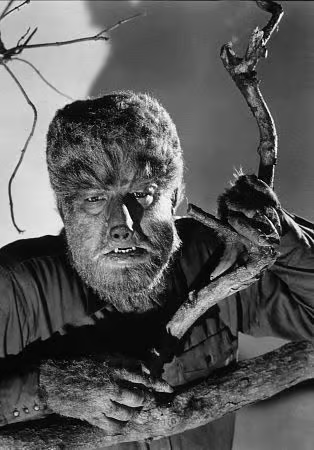
The Wolfman (1941), starring Lon Chaney Jr. (image above) is credited with perpetuating the most common werewolf stereotypes, including a man who is bitten by a werewolf and subsequently becomes one himself, transformations under a full Moon, and murders committed at night by a tormented werewolf that are subsequently mostly forgotten in the morning. This movie also featured the metal silver, in the form of a silver walking cane with a wolf emblem purchased by Lon Chaney’s character at the beginning of the movie. The film did not, however, feature silver bullets.
A series of werewolf copy-cat movies, many of them bad, subsequently appeared in the 1940s and again in the 1960s and 70s. The decade of the 1980s was the modern ‘golden age’ of quality werewolf films, beginning with The Howling (1980), followed by An American Werewolf in London (1981), and perhaps the most stylish werewolf movie ever done, Neil Jordan’s The Company of Wolves (1984), which was an elaboration of Grimm’s Little Red Riding Hood fable. Early 21st century efforts have included Ginger Snaps (2000), and the multiple Underworld and Twilight films, two series which were box office successes but generally derided by critics. (Underworld in particular seemed little more than a Matrix derivative).
Two original and interesting films that dealt with the werewolf theme but did not specifically involve werewolves, were Wolfen (1981), based on Whitley Strieber’s 1978 novel about a pack of relatively advanced entities resembling wolves terrorizing urban slums; and Brotherhood of the Wolf (France, 2001), based in part on the true story of ‘the Beast of Gévaudan’, concerning an alleged wolf-like creature (or creatures) killing people in a region of southern France during the 1760s. The latter film appears also to have taken its lead from the notorious ‘Leopard-Man’ killings of Nigeria during the 1940s (for both stories, see below). The movie has a twist at the end that involves a trained creature being used as a pawn by a secret society bent on overthrowing the king.
Werewolves in Lore
The word ‘werewolf’ originates in the Old English terms wer (‘man’) and wulf (‘wolf’); the word has been in use as far back as 1000 CE. The wolf throughout history has served as an intense mirror for human nature because as much as any other animal it has been seen in a heavily polarized light. On the one hand, it has been associated with the antisocial and the disloyal, along with savage impulse, lack of conscience, and outright evil. On the other hand it has also been connected to bravery, loyalty, and the power of team-work, family, organization, or nation (the ‘pack’) to overcome obstacles. This is an obvious metaphor for human nature. What marks the psychology of the human being as much as anything is the division between the polar potentials for sublime wisdom and nobility of character alongside the capacity for sheer self-centered depravity and destructive malice.
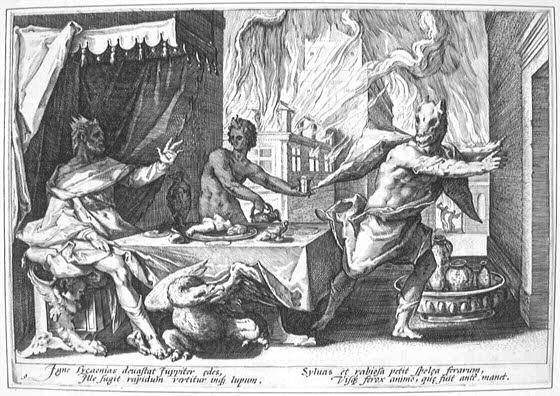
The earliest recorded mention of humans changing into wolves is from ancient Greek literature, in specific from the Balkan area known as Arcadia. Legend has it that this land was ruled by a king named Lycaon (circa 1500 BCE), who also promoted the worship of Zeus. (The Eastern timber wolf derives its scientific nomenclature—Canis lupus Lycaon—from this Greek legend). Lycaon’s sons—according to some versions of the myth there were as many as fifty of them—like typical privileged offspring, were reportedly subversive and arrogant. This matter came to Zeus’s attention who decided to monitor them ‘undercover’, disguised as a common worker. In a visit to Lycaon’s house the undercover Zeus was fed a vile mix of flesh from a sacrificed human child and animal entrails (the purpose being to determine if the stranger was actually Zeus). Angered at the murder of the child, Zeus turned Lycaon into a wolf. Some versions of the myth have him turning all his sons into wolves as well; other versions have him killing the sons with a lightening bolt. (It is from this legend that the technical term for werewolfery, ‘lycanthropy’, derives).
From this myth we can see the coincidental nature of the association of the wolf with evil intent. At the simplest level, werewolf legends are in part a reflection of the reality of sharing a territory with a particular predator. Prior to the human depredations of wolves of the 20th century, the wolf was the dominant predator in Europe alongside Man. Predictably, it is from these lands that the werewolf legend has been strongest (such as in Scandinavia, for example). In India there has been the belief in the weretiger, in South America the werejaguar, and in Japan the werefox, and so forth.
In Africa, there have been the wereleopards and werelions. Belief in the former was famously found amongst a group calling itself the Leopard Society—eighteen members of which were executed in Nigeria in 1946 for ‘terrorizing’ a town, in which up to two hundred victims appeared to have been mysteriously killed by man-leopards.1 The matter of werelions came to light in a series of arrests in 1947 in Tanganyika (today part of Tanzania) in which close to seventy ‘Lion Men’ were accused of carrying out various acts of mayhem (including murder) while dressed up in lion skins and leaving wounds resembling marks from lion claws. These acts, some of which were ritualistic, were in some instances motivated by the ancient theme of blood-sacrifice, where the belief is that by a ritualistic killing certain merits will be achieved and blessings accorded from deities (such as good weather, crops, hunting, and other benefits).2
Werewolf killings have traditionally been of the lurid sort, often involving sexual depravities and the eating of human flesh (commonly of the young and/or female). Doubtless for a significant number of these cases the root of the matter was straightforward: mental illness (including hallucinations) and psychopathic behavior.3 But in cases where these stories are mere legend, or delusions or fabrications extracted under torture (common during the various Inquisitions), the sources of this appear to be connected to old beliefs around the power, or other attributes, that can be obtained by consuming the flesh or blood of an enemy or other victim with desired qualities. (As far back as Plato this idea has been used as an allegory to warn about the likely end result: in The Republic, Socrates’ forecast that any leader who plots to eliminate a political rival—for which he uses the metaphor ‘tasting human flesh’—will himself become a tyrant. Cf. Nietzsche’s famous expression, ‘be on your guard not to become the monster that you hunt!’).
Other sources of the legend are clear, such as the Norse traditions of warriors dressing up in the skins of bears they had killed. These warriors, termed berserkers, were renowned for a superhuman strength and fierceness in battle that was compared to trance or frenzy (hence the root of the word ‘berserk’). From this it was easy to credit the warrior with the power of the beast he dressed up as.5 The follow up meaning came to represent a person mentally disturbed in such a way that he believed he actually was the beast. This latter usually goes by the designation ‘clinical lycanthropy’.
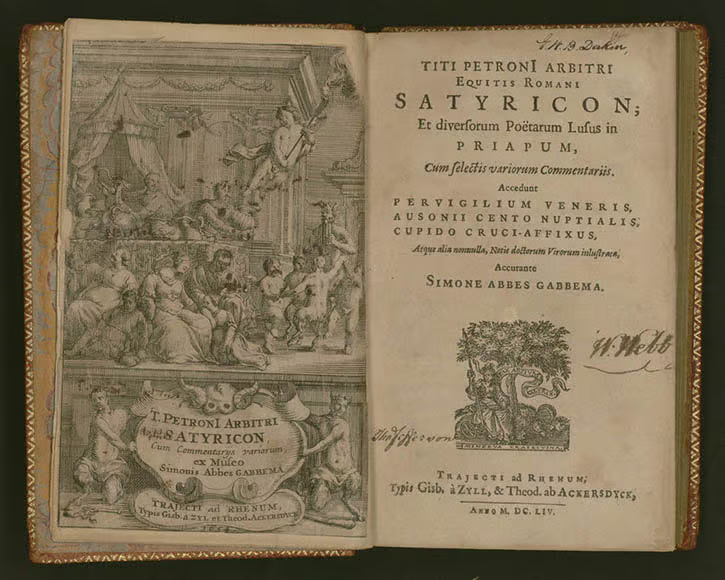
Some of the classic roots of the werewolf legend can also be traced to the famed novel Satyricon, written by the Roman Gaius Petronius (27-66 C.E.), which was rendered into the equally famed Fellini’s Satyricon, a 1969 film by the renowned Italian director Federico Fellini.6 Petronius’ Satyricon contains a chapter called The Feast of Trimalchio, centering on a wealthy and pretentious former slave who entertains his guests with lavish excess. During a particular feast he regales them with stories, one of which involves him and a companion who go out one night on a walk that takes them near a cemetery. While there, Trimalchio’s companion suddenly disrobes, proceeds to urinate in a circle around them, turns into a wolf, and then runs off into the woods, howling as he goes. Trimalchio finds that the man’s clothes have turned to stone. He then visits his mistress who tells him that a wolf just attacked their cattle, but was driven off with a pitchfork to the neck. Come morning Trimalchio returns home, only to find his companion suffering a pitchfork wound on his neck and being attended to by a doctor. He then concludes that the man is a versipella (werewolf). Rossell Hope Robbins noted that this story contains four essential elements of werewolf legend: nocturnal transformation, nudity, urination and/or related specific magical acts, and ‘sympathetic wounding’.7 The latter factor, the wounding of a wolf and the later capture of a human with a similar wound, was actually used as proof in European werewolf trials,8 the height of which corresponded roughly to the peak of the witch-hunting craze in the 16th century. (The fact that most witch-hunting took place in Germany and France, and that it was these two countries that saw the most accusations and trials concerning alleged werewolves as well, strengthens the likelihood that mass hysteria was at work).
The theme of ‘sympathetic wounding’ was central in one of the more renowned werewolf trials of that time, which occurred in the district of Poligny, France, in 1521. The story begins with a traveler passing through Poligny who is ambushed by a wolf. The traveler survives, trails the wolf, and ends up at a small house where he discovers a wounded man who is being treated by his wife. The traveler reports the wounded man—his name was Michel Verdung—to the authorities, who arrest him.
Presumably under torture Verdung told an elaborate story that implicated another man, Pierre Bourgot. This man in turn made his own confession, which placed his ‘dealings with the Devil’ originating nearly twenty years before, in 1502. Bourget claimed that at that time, following a storm that had frightened off his sheep, he was confronted by three ‘black horsemen’, one of whom offered to help him in exchange for a vow of loyalty. Bourgot agreed, and to his relief his flock was soon found. In a subsequent meeting one of the horsemen revealed himself to be a disciple of the Devil, and extracted a further oath of obedience from Pierre, who consecrated this oath by kissing the horseman’s left hand, which he described as black and ice cold. After a couple of years Pierre began to lose his connection with the Devil’s disciple and appeared to be re-associating with the Christian faith again. Michel Verdung, another of the Devil’s servants, set to work luring Pierre back into the satanic fold with promises of riches. Pierre then attended a sabbat, during which he was made to apply an ointment of some sort (a common theme in werewolf stories). Pierre then found himself turning into a wolf; with the aid of Michel Verdung he was able to revert to his human form. Confessions were extracted from Pierre Bourgot under torture. Amongst other lurid actions he admitted to killing children, which including eating at least two girls under the age of ten, and describing their taste as ‘delicious’. He also claimed he fornicated with wolves. Bourgot, Verdung, and another ‘werewolf’, Philippe Mentot, were all tortured and then burned at the stake.9
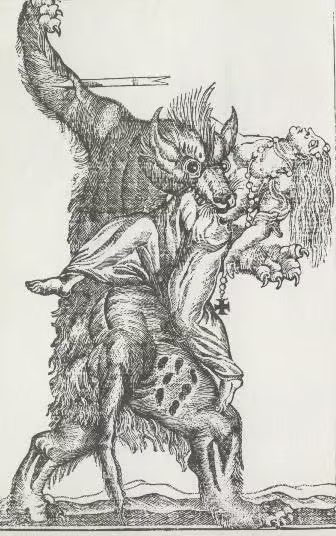
Two more sordid examples are illustrative of possible connections between some lycanthropy cases and the modern designation ‘psychopathic serial killer’: those of Gilles Garnier and Peter Stubb. The former was a hermit who was declared a werewolf and executed in France in 1574. He had been accused of murdering and eating children. He confessed that he had been in the form of a wolf when he did these killings, and claimed to have often dragged his victim away with his ‘fangs’. On one occasion Garnier was caught with one of his victims by some peasants who later agreed that he was in the shape of a wolf-man—body of a wolf, yet with his human face still recognizable. Garnier was forced to confess to making a pact with the Devil, convicted and burnt at the stake. (The actual story was that a wolf had killed some local children, and Garnier, starving, was caught scavenging the carcass of the child—which during that time easily became grounds for being accused of something more sinister than scavenging).10 The latter story, concerning the German Peter Stubb, occurred near Cologne in 1589; at the time, it was one of the more famous werewolf trials in Europe. Stubb claimed to have a ‘magic belt’ that enabled him to transform into a powerful and ravenous wolf. Similar to Garnier he was accused of preying on women and young people, from as far back as 1561. He further claimed that throughout his nearly three decades of raping and killing he had been influenced by a ‘succubus’ (a female demon said to visit men at night; the male counterpart is called an ‘incubus’). Stubb was tortured in the harshest fashion, then decapitated, then burned. Colin Wilson speculated that the cruelty of the torture may have resulted in fabricated confessions, which doubtless was often the case with so-called witches and lycanthropes.11 However it is also possible that this was an actual case of a 16th century schizophrenic serial killer.
There were a number of other relatively high profile trials involving alleged werewolves in Europe; most of these were in the late 16th century, and most occurred in France. It’s unclear why there was a concentration of cases at that time in that part of the world—apart from the simple demographic fact that France was the most populated country in Europe throughout the Middle Ages and into the early modern era—but it may have been no more than the power of transmitted suggestion and mass-hysteria.
At any rate, one of the more infamous cases occurred later, in the late 18th century, when werewolf cases had become rarer (most witch-trials has stopped by then as well). It concerned the ‘Beast of Gévaudan’, the name given for the alleged creature (or creatures) behind a series of killings between 1764 and 1767 in south-central France in the former province of Gévaudan (modern-day Lozère). Word about these killing traveled widely. The London Magazine of January 1765 reported:
‘…a detachment of dragoons [light cavalry] has been out six weeks after him. The province has offered a thousand crowns to any persons that will kill him.’12
During this three year stretch, in a mountainous area ranging over two thousand square miles, some two hundred attacks were allegedly made, resulting in at least sixty-four deaths, and possibly over a hundred. The creature or creatures making these killings was never clearly determined; reports were made describing a vicious and foul-smelling beast that some thought resembled an African wildcat (lion, tiger, panther) or even a hyena. Reportedly it could leap to great heights, and had a large and deadly tail to accompany its lethal fangs.
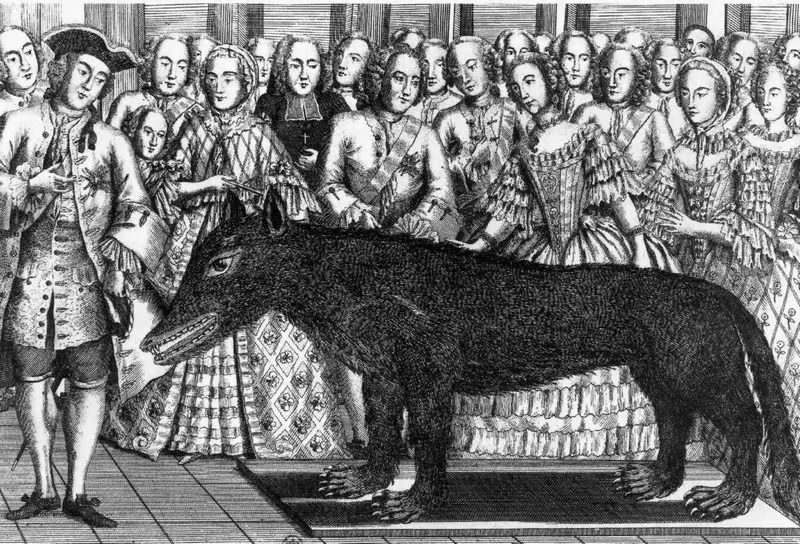
Most of the victims were children. The matter came to the attention of King Louis XV, who commanded small armies to track down the creature. Despite some two thousand wolves being shot, the army failed to find the culprits. Eventually an elderly hunter named Francois Antoine succeeded in killing a large animal that weighed 130 pounds and was some 32 inches high at the shoulder (consistent with the dimensions of a large male Gray wolf). This animal was identified by some surviving victims as the culprit (it was subsequently stuffed and displayed for the king at Versailles). However, even after this cull, killings of dozens of people, some of whom were children, continued to be reported. Finally another hunter, 59 year old Jean Chastel, succeeded in killing a creature in 1767. Upon opening its stomach, he discovered human remains. Shortly after this, the killings stopped. This story was rendered into a novel in 1936 by Abel Chevally (La Bete du Gévaudan), where it was embellished by adding the legend that a pious and praying Charest killed the ‘evil beast’ with two silver bullets (and hence the origin of the legend).13 Later speculation is that this ‘beast’ was a wolf-dog hybrid, which can be larger and more aggressive than either of its parents (and less likely to fear humans).14
The eccentric English scholar and Christian fundamentalist Montague Summers, in his prodigiously researched work The Werewolf in Lore and Legend, wrote,
…belief in the werewolf by its very antiquity and its universality affords accumulated evidence that there is at least some extremely significant and vital element of truth in this dateless tradition, however disguised and distorted it may have become in later days by the fantasies and poetry of the epic sagas, roundel, and romance.15
Summers’ motivation for uncovering this ‘vital element of truth’ may have been compromised by his Christian ‘Devil-hunting’ agenda, but there is a truth buried in his speculation, and indeed it lies at the basis of this study. The ‘disguised truth’ does not involve, however, anything as banal as actual men turning into berserk werewolves and committing atrocities under cold moonlight (although clearly, such atrocities occurred, regardless of their cause). The distorted practice detectable in werewolf legends that we are more interested in here concerns a bona-fide and ancient shamanistic tradition: shapeshifting.
Shapeshifting
‘Shapeshifting’ is a late 20th century term devised to describe ancient beliefs and practices found in most worldwide cultures. In its broadest sense it refers simply to the ability of a person to change their form, usually into the form of an animal, but it can also suggest a change into the form of any other entity, including human or imaginary creature.
Shapeshifting is a practice closely related to ‘sympathetic’ or ‘imitative magic’. Probably the crudest form of this practice is the common act, frequently engaged in by protesting groups or crowds, of burning an effigy. In destroying the effigy it is believed that this will bring some sort of ill fate to the likeness of the effigy. Certain practices of what are sometimes categorized as black magic or sorcery are based on this, with the stereotype of the magician or sorcerer who sticks pins into a doll that represents an actual person. The more evolved form of this magic is based on the idea that by mimicking something, we can become more deeply attuned to it, and thereby understand it more fully, and, if desirable, even gain some of its qualities.
We can also, provided we have the intent, manipulate, control, or otherwise effect what we are imitating by first, establishing a ‘resonance alignment’ with it, and second, changing our own behavior in such a fashion that this change will cause the object of our focus to change in a similar fashion. (This is similar to certain behavioral practices called ‘mirroring’, something many good salespeople either know of, or do naturally. If you adopt a person’s mannerisms in a sufficiently subtle fashion, it can result in them feeling more relaxed and ‘in tune’ with you, which in turn may cause them to be more agreeable to buying your product. This is also similar to a psychotherapeutic tool called ‘reality pacing’, in which the therapist achieves a strong rapport with their client by deeply acknowledging their point of view, which in turn results in the client feeling ‘understood’, and in turn, more likely to be open to positive and constructive use of the therapy).
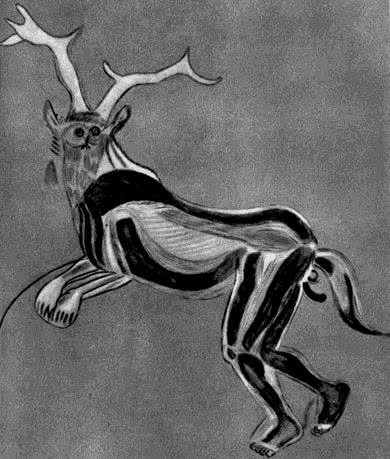
One of the oldest pieces of art work known, the approximately 14,000 year old ‘Les Trois Freres’ cave paintings in southern France, contains a particular rendering that has long been cause for deep speculation. The image has come to be known as ‘The Sorcerer’ (shown above). It depicts what appears to be a dancing man dressed up in a costume of sorts that seems to be a composite of different animals. Alternately, is has been speculated that the image shows a man who has partially transformed into an animal, or who himself may simply be part animal.
The main idea behind a ‘shaman’—the modern term for a practitioner of primordial magic—dancing as an animal, or otherwise seeking to attune deeply to the spirit of an animal, is mainly so that the shaman can acquire some of its natural powers. These ‘natural powers’ can be understood in terms of subtle, psychological or spiritual aspects—the courage of a lion, the perspective of a hawk, the grandness of an eagle, the power of a tiger or bear, the gentleness of a deer, the cunning of a fox, and so on. They can also be seen in terms of simple physical qualities—physical power, strength, endurance, health, etc. In many worldwide shamanistic traditions, it is believed that the act of deliberately attuning to the spirit of a particular animal is to ‘acquire’ a guardian spirit (or sometimes called a ‘totem’ or ‘power animal’) based on the energies of the entire species represented by the animal. In other words, to acquire an eagle power animal is to tap into the collective power of Eagle; to acquire a bear power animal is to receive the help of Bear, and so on.
The technical term for shapeshifting is therianthropy (from the Greek therion, ‘wild beast’, and anthropos, ‘human’). The term ‘shapeshifting’ is somewhat misleading, as the vast majority of shamanistic traditions dealing with this matter eventually acknowledge that so-called shapeshifting is in fact an altered state of consciousness, and thus is a transformation of perception, not physical form. (Which, in the shamanistic context, does not diminish the value and purpose of it).
That said, the difference between ‘shift in perception’ and ‘shift in form’ was doubtless rarely understood and even now is not always openly clarified, no doubt in large part due to the common folk of past times believing in the physical reality of therianthropes of whatever sort. The anthropologist Michael Harner, in his popular work The Way of the Shaman (1982), reported how the belief in shapeshifting is widespread in shamanistic traditions the world over.16 He mentions the pervasiveness of the belief in North, Central and South American Indian mythology, amongst Australian aborigines, Scandinavian Lapp (where werewolfery is especially prevalent), Siberians and the Inuit, throughout Africa, and so on.
Harner’s popularization of the shamanic traditions came closely on the heels of Carlos Castaneda’s famous (or infamous, take your pick) and highly influential books describing his alleged apprenticeship to a Yaqui Indian shaman named ‘don Juan Matus’. (He ended up publishing twelve books, but the first three—The Teachings of Don Juan, A Separate Reality, and Journey to Ixtlan, all brought out between 1968 and 1972, remain his most famous). In some of his books Castaneda described his own ‘transformation’ into a crow. In particular Castaneda went a long way toward conveying the importance of perception in experience, and of the meaning and purpose of altered states of consciousness. As a trained anthropologist and a fine writer, Castaneda’s works made for compelling reading. He was more or less ‘outed’ in the late 1970s by scholar Richard DeMille, who demonstrated almost irrefutably that Castaneda had fabricated most, if not all, of his story. Nevertheless as Harner and others have shown, Castaneda was drawing the substance of his ideas from legitimate sources. He had a gift for ‘bringing to life’ shamanistic ideas that previously had been the province of dry academic texts.
Both Harner and Castaneda were preceded by the Romanian scholar Mircea Eliade, who in 1951 put out his landmark work Shamanism: Archaic Techniques of Ecstasy. This work went a long way toward shedding light on a key matter related to shapeshifting, and that is the question of the so-called ‘familiar’ or ‘helping spirit’. The word ‘familiar’ relates to family-intimacy; in late 16th century Europe (more or less the peak period of both witch and werewolf trials) the word also came to be used to represent the ‘evil helping spirit’ of a witch or sorcerer. The historian James Sharpe noted,
…the idea that a witch was usually assisted by a familiar in the shape of an animal constantly recurred in pamphlet accounts; indeed it was present in two of the first surviving pamphlets concerned with witchcraft, both published in 1566…17
It’s ironic to note that the more astute scholars of that time held a view that discounted the possibility of actual shapeshifting, seeing it all rather as illusion or perceptual tricks—and yet at the same time, ascribed a supernatural cause to these illusions—namely, that they were the work of the Devil. In 1608 the Italian clergyman Francesco Guazzo published his Compendium Maleficarum (a ‘study’ of witches), in which he wrote,
…As I have already said, no one must let himself think that a man can really be changed into a beast, or a beast into a real man; for these are magic portents and illusions…for the Devil, as I have said elsewhere, deceived our senses in various ways. Sometimes he substitutes another body, while the witches themselves are absent…and himself assumes the body of a wolf formed from the air and wrapped around him, and does those actions which men think are done by the wretched absent witch who is asleep.18
Werewolfery was impossible, and thus an illusion: but an illusion created by the Devil. It was a twisted synthesis of critical thinking and religious dogma.
Lurid and even erotic powers were ascribed to some ‘familiar’ spirits, such as the bizarre practice of sucking blood from the genitalia or the anus of the witch.19 This was all seen as a variant of the belief, prevalent on continental Europe of that time, that insisted that the Devil had wild orgies with witches during late night ceremonies called ‘sabbats’. However as legitimate shamanistic traditions bear out, the ‘familiar’ or ‘helping spirit’ is not seen as lascivious, let alone evil; on the contrary, it is generally regarded as a benevolent assistant, loyal, trustworthy, and able to instill helpful power into the shaman who invokes it.
Eliade defined three essential categories of ‘spirits’ within the shaman’s world: ‘familiars’ or ‘helping spirits’; ‘tutelary spirits’; and ‘divine or semi-divine beings’.20 It is the first group, the ‘helping spirits’, which is of interest in the matter of shapeshifting. Another late 20th century term that has become popular for this class of totem entity is ‘power-animal’.
A common theme in shamanic tradition is that of the shaman undergoing a key process of awakening (or ‘illumination’), after which he must retreat to a wild and natural setting and obtain a helping spirit. This usually occurs via the shaman entering some sort of trance or altered state of consciousness (as via dance, drumming, meditation, hallucinogens, etc.). When the ‘helping spirit’ comes to him he enters into a deep communion with it, to the point of taking on some of its behavior and characteristics:
The spirits all manifest themselves through the shaman, making strange noises, unintelligible sounds, etc.21
The helping spirit is almost always the spirit-form of a particular animal. Eliade clarified that this process is not the same as ‘possession’, in that the shaman is acting willfully and voluntarily—and that if anything, the process is reversed, in that it is the shaman who is taking possession of the helping spirit. The helping spirit is of great importance to the shaman, as it represents the shaman’s ability to navigate the ‘bridge’ between the physical dimension and the ‘other worlds’. Many worldwide traditions feature legends of the ‘psychopomp’, the term for a spirit-guide who ushers the soul of a dead person to and through the Other Side, or even to become the new form of the deceased person.22 Commonly this spirit-guide is in the form of an animal (for e.g., the Egyptian jackal-god or wild dog-god Anubis).
The ‘tutelary spirit’ is generally understood to be a guardian spirit of a very high order, and in some respects correlates to the idea of the ‘Holy Guardian Angel’ that is central to many mystical schools of the Western esoteric tradition. This spirit is, in fact, the higher self of the person, but seen from the perspective of the personality it appears to be a distinct entity that ‘guards’ or ‘oversees’ the person’s life. In describing beliefs among shamans of Siberia and Mongolia, Eliade writes,
The tutelary animal of the Buryat shamans is called the khubilgan, a term that can be interpreted as ‘metamorphosis’ (from khubilkhu, ‘to change oneself’, ‘to take on another form’). In other words, the tutelary animal not only enables the shaman to transform himself; it is in a manner his ‘double’, his alter ego. This alter ego is one of the shaman’s ‘souls’, the ‘life soul’.23
As Eliade astutely noted, the whole basis of the shaman’s connection to the helping spirit relates to not just his ability to travel ‘between worlds’, but also to his ability to undergo ‘death and resurrection’ by overcoming the limitations of material existence. In short, the ability to shapeshift ultimately relates to the ability to conquer death by undergoing an initiation that thematically involves death itself. Not the death of simply the body, but the death of what we can call egocentric delusions brought about by attachment to material form.
The Psychology of Familiars and Shapeshifting
To further increase our perspective on all this, it’s helpful to discuss briefly the psychology of shapeshifting. Before doing so it should be clarified, however, that the traditional shaman is a metaphysical realist, in the sense of believing that the various dimensions and entities contacted actually exist outside of his or her own mind.24 Any attempts at psychological interpretation in the matter of shamanic practices needs to be tempered with this understanding. That doesn’t have to stop us, however, from looking at the big picture. Whether we regard something as ‘outside’ of our consciousness or not, we still have to come to terms with the lesson that the experience represents for us if we wish to understand ourselves better. This is true for any wishing to understand the underlying psychology of certain shamanistic practices.
First, to look at the obvious: the question of mental illness. As mentioned above in the discussions of some of the actual werewolf trials of Renaissance Europe, the cases that involved murders and other criminal depravities (as opposed to ‘confessions’ fabricated under pain of torture) were quite clearly examples of what today would be called psychopathy. There is however a ‘milder’ form of mental illness connected to mystical experiences, what the psychiatrist Roger Walsh called ‘mystical experiences with psychotic features’. Walsh cited transpersonal psychologists Stanislav and Christina Grof who noted in their studying the cases of ‘ordinary’ people who underwent spiritual crises that their mystical experiences often involved themes such as great suffering (breakdown of some sort) and symbolic death, followed by ‘rebirth’, ‘ascent and magical flight’, and even ‘communication with animals or animal spirits’.
Walsh goes on to discuss a shamanic phenomenon of particular relevance to a chapter on werewolves, that being ‘possession’:
Experiences of possession have been described throughout history and may be a major feature of the shamanic crisis. Today they may occur either spontaneously or in religious or psychotherapeutic settings. The experiences battling with or being overwhelmed by rage and hatred can be of hideous intensity. So powerful, repugnant, and alien do these emotions feel that they seem literally demonic, and the victim may fear he is engaged in a desperate battle for his very life and sanity.25
He goes on to point out, however, that the entire matter can be understood as a process of shedding an old self-image, i.e., a type of spiritual metamorphosis:
Psychiatrist John Perry has described the renewal process as an experience of profound, all-encompassing destruction followed by regeneration…yet this destruction is not the end but rather is a prelude to rebirth and regeneration.26
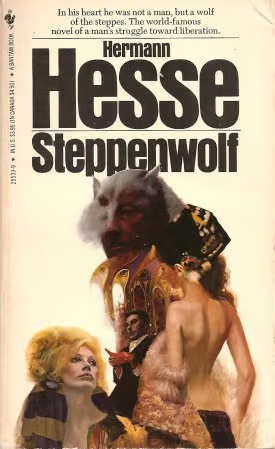
The ‘degraded’ form of this process of shamanic death, regeneration, and rebirth is well symbolized by the dark, blindly destructive face of the werewolf—the end result of a tormented transformation into a powerful beast (in effect, possession), under moonlight. For the werewolf, the ‘rebirth’ never comes. There are only endless deaths (losing consciousness) and transformations which he has no ability to control. (The German novelist Herman Hesse, in his 1927 novel Steppenwolf, about a man inwardly conflicted over the tug-of-war between his ‘high, spiritual’ side and his ‘low, animalistic’ side, described the process more in terms of social alienation, rejection of bourgeois values and mainstream mediocrity. This is an example of what Colin Wilson called an ‘Outsider’, one who instinctively seeks to move beyond the mediocrity of the masses, but in most cases lack the guidance, or the ability to ‘regenerate’ and re-invent themselves in a fulfilling manner).
True shamanic practice involves voluntary intent in the matter of regeneration and rebirth. From the point of view of a person seeking (consciously or not) to become inwardly unified, integrated, a whole person, the ultimate spiritual purpose of associating with ‘familiars’ or the practice of shapeshifting is becoming more conscious of elements of one’s own nature. The key, of course, is consciousness. We cannot integrate a part of our nature without first becoming aware of it. We cannot integrate our ‘inner beast’ and all the ways its energies become manifest, without first seeing and understanding something of the nature of this beast.
In referring to the tale of the wizard Faust and the devil he conjures (Mephistopheles), C.G. Jung wrote,
Mephistopheles is the diabolical aspect of every psychic function that has broken loose from the hierarchy of the total psyche and now enjoys independence and absolute power. But this can be perceived only when the function becomes a separate entity and is objectivated or personified…’27
Magical evocation—the classical practice of a wizard or magician standing in a circle fortified by Holy Names and ‘raising a spirit’ by calling it forth via various magical formulae—is essentially the ritualized equivalent of the shaman acquiring a helping spirit. (It goes without saying that the ‘type’ of spirit being raised, its disposition and qualities, can vary greatly). Seen from a psychological perspective, this represents ‘calling forth’ elements of the magician’s psyche so that he can objectify them and begin to understand them. (In alchemy, this stage corresponds to necessary processes defined by various forms of separation, prior to recombining them). ‘Understanding them’ does not, of course, mean that the magician or shaman automatically understands how the ‘spirit’ ultimately reflects a quality or potential within the magician or shaman’s own psyche. This point is crucial. Things are degraded when they are disconnected, disintegrated, spread out and scattered. The risk in ‘evoking’ parts of our nature to objective reality is that we may be so disturbed by what we see that we disown these parts, or worse, project them on to others, who then become our convenient scapegoats.
The psycho-spiritual purpose of shapeshifting can be only one: to objectify parts of our nature, establish a relationship with them, and ‘re-absorb’ them by owning and taking responsibility for their energies—which are, after all, our energies. In so doing we integrate their qualities. In so doing, we become more Whole.
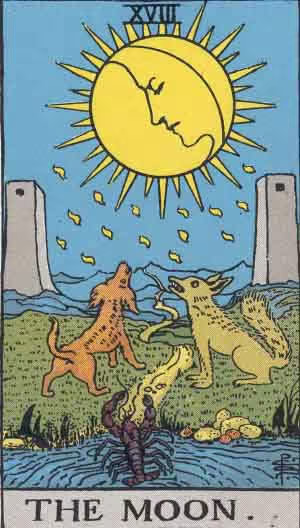
The ‘wolfman’ is part of human nature—aggressive impulse, secretive and repressed, potentially destructive—for whatever causes. It has been commonly associated with masculine impulse, but it is alive and well in the feminine mind also, hinted at in its legendary connection with the lunar cycle, and further shown in the traditional Moon card of the Tarot, which commonly features a dog howling at the Moon. Man or woman, we need not undergo a writhing and tormented transformation into a murderous beast under a full Moon—that is, we need not deny and repress our aggressive impulses, by becoming secretive or furtive about them. As Jung wrote,
…we have to expose ourselves to the animal impulses of the unconscious without identifying with them and without ‘running away’; for flight from the unconscious would defeat the purpose of the whole proceeding. We must hold our ground, which means here that the process initiated by…self-observation must be experienced in all its ramifications and then articulated with consciousness to the best of understanding.28
Finally, it bears mentioning that a term from alchemy—antimony (an actual chemical element with the atomic number of 51)—referred to the hidden wild beast within, and was associated with the wolf in medieval texts. It particularly pointed toward the shadow element of the monk or priest, something that has become all too much a matter of common knowledge.
Deity Yoga and the Assumption of God-forms
If the brutal and twisted imagery of the werewolf—secretive, cursed, predatory, preying mostly on women and children, the ghoul of every Little Red Riding Hood’s worst nightmare—represents some of the more degraded elements of imagination, then the esoteric practices known as the ‘assumption of god-forms’ and ‘deity yoga’ represent some of its most elevated.
As indicated above, in psychological language the werewolf is simply a part of the ‘Shadow’. As with all Shadow-work, the aim is not to run away from this energy, nor to indulge it, but rather to courageously face into it, embrace it, and transmute its powerful energies. In so doing, the vitality, creativity, and power of the Shadow are freed up, minus the secretiveness, hostility and aggression. Much as with a powerful ‘problem child’, we need to establish a profound level of relationship with this energy and ultimately take responsibility for the reality that it is not our ‘feral child’, it is rather part of us.
Tibetan Buddhism, being a unique amalgam of rarefied Indian Buddhist metaphysics and earthy Tibetan shamanism, developed particular methods for working with and transforming some of the darkest and densest energies of the Shadow. Some of these practices are included in parts of what is usually termed ‘deity-yoga’, and they involve utilizing particular tutelary deities as yidams (the Sanskrit equivalent term is Ishta-deva, meaning ‘deity that is desired and given reverence to’). A yidam is a celestial being that is the object of personal focus and devotion, either for a spiritual retreat, or as a life-long object of meditation.
In the Tibetan Buddhist pantheon, many exalted deities are recognized, but three very important ones are Chenrezig (the lord of Compassion, known in India as Avalokiteshvara and in China as Kuan Yin); Manjushri, lord of Wisdom; and Vajrapani, lord of Power. These deities in turn all have a ‘wrathful aspect’—for Chenrezig, Mahakala; for Manjushri, Yamantaka; and the wrathful face of Vajrapani (which usually goes by the same name). These ‘wrathful deities’ all appear, to one unaware of Tibetan Buddhist teachings, as simply demonic—fierce, ugly, threatening, often adorned with skulls and of a terrifying disposition. But the three just mentioned are not demons; they are expressions of ‘active wisdom’, ‘active compassion’, and ‘active power’, respectively. According to the teachings they exist in part to protect the dharma (Buddhist teachings), and any practitioner who calls on them, a Protector/Guide theme that is found in many worldwide spiritual mythologies. But there is a subtler, deeper teaching involved here, and it has to do with the ‘taming’ and integration of Shadow-energies. The fierce deities of Tibetan Buddhism can be thought of as masters of ‘tough love’, fearless and courageous, spiritual warriors ready to deal with the darkest faces of our egos. They do this not by beating these parts of our nature into submission, but rather by resonating with them, entering their worlds, speaking their language, so to speak, so as to acquire their trust. In so doing, they are then capable of guiding these parts of our darker nature back into the light of integrated awareness.
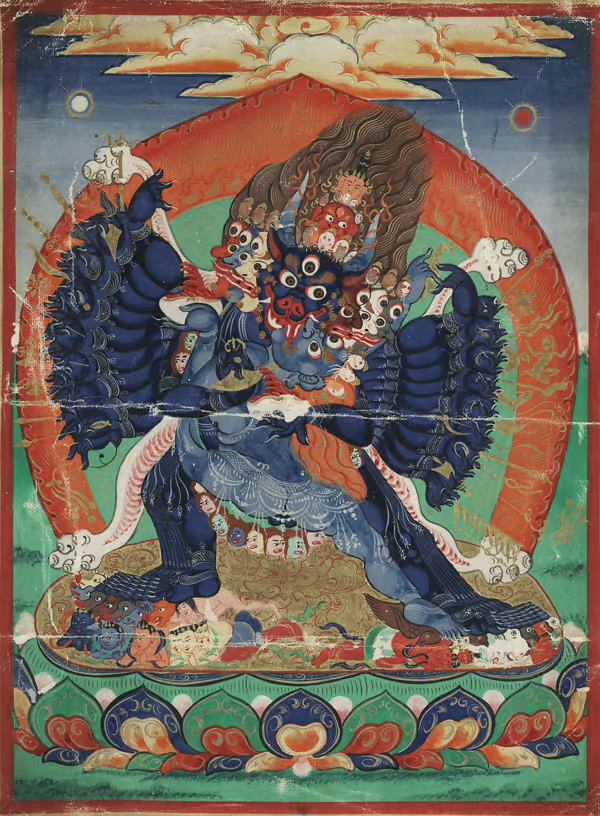
In referring to Yamantaka, the wrathful aspect of Manjushri (lord of Wisdom), Buddhist psychologist Rob Preece wrote,
Yamantaka gives the forces of the Shadow a symbol that hooks their energy and provides a channel and direction for their expression and transformation…he is able to harness their energy and embody their power consciously. The archetypal forces of the instincts and emotions held in the Shadow are given a channel through Yamantaka so that they can be brought into consciousness, transformed, and integrated…as the Shadow forces are transformed, their energy is not lost, but integrated into personal power.29
Preece also cited the vivid analogy of a gang of biker thugs gone out of control (representing our Shadow-elements that are disconnected and ‘acting out’, such as impulsive anger, tendencies toward depression, unhinged jealousy, etc.). He then asks how such thugs should correctly be ‘put in their place’, and suggests that it will not be effectively done by a mild-mannered sort, but most likely by one who resembled a biker-tough guy himself, and yet is really an advanced teacher and evolved being. That is what a wrathful deity like Yamantaka represents: the highest expression of tough love.
However, the deeper point is to understand that the wrathful deities are not actually separate from us. They are elements of our own nature. The difference between them and a tormented creature like a werewolf is that they are using their power and aggression in the service of a higher purpose. The werewolf is the beast with no purpose, no reason for being; a furtive expression of repressed and distorted passion. When purpose is squashed, when there exists no other reason for being than serving someone else’s agenda, then hostility breeds, and seeks outlets.
The fundamental motivating force toward a higher purpose is compassion, precisely because ‘higher purpose’ always, without fail, involves playing a role in the awakening and evolution of the human being. Accordingly, this compassion is cultivated with a view toward helping others develop and awaken to their true nature as beings of unlimited potential. And the key quality in this compassion is enthusiasm. The English word ‘enthusiasm’ derives from the Greek terms enthousiasmos and entheos, both of which relate to ‘divine inspiration’ and the idea of being ecstatically possessed by a divine being.
The idea of merging with a divine being is ancient, and found within many world myths and wisdom traditions. It is very common in ancient Egyptian tradition but perhaps in ways that have not always been correctly interpreted, an idea that was developed by Jeremy Naydler in his seminal work Shamanic Wisdom in the Pyramid Texts.30 Naydler argued that ancient Egyptian writings preserved in the famous Pyramid texts are more than simple funerary arrangements or frivolous mythology, but are rather teachings describing the initiatic process of awakening to the divine on Earth, while alive, and not just in some after-life. Naydler wrote:
The role of the shaman as mediator between the ‘nonordinary’ reality of the spirit world and the ordinary reality of the sense-perceptible world is in many respects paralleled in ancient Egypt by the Egyptian king, whose role is similarly to act as mediator between worlds. Such important shamanic themes as the initiatory death and dismemberment followed by rebirth and renewal, the transformation of the shaman into a power animal, the ecstatic ascent to the sky, and the crossing of the threshold of death in order to commune with ancestors and gods are all to be found in the Pyramid Texts…31
The Western esoteric practice known usually as ‘the assumption of Godforms’ involves extensive usage of imagination. This is done via the practice of visualizing in detail the particular god (usually Egyptian) chosen to unify with. As esoteric scholar Arthur Versluis wrote, in referring to ancient Egyptian practices of identifying with particular deities,
…to be the God, to not only mirror, but to attain complete identification with the God, with that state of consciousness, was the aim of initiatory ritual as such.32
The result is intended to change or transmute the seeker’s ‘Body of Light’ (recall our discussion of this in the chapter on Frankenstein) into the ‘Body of God’. That is the ageless goal of mysticism and high magic: union with the Source.
The Western esoteric practices of assuming Godforms are, of course, very similar to the Tibetan Buddhist practices of deity yoga mentioned above, although it should be pointed out that the Tibetan systems generally emphasize the necessity of developing compassion and understanding emptiness (the intrinsic formlessness of ultimate reality) prior to engaging the visualization work. There are also preliminary trainings in Western esoterica, but they relate more to the development of will and imagination rather than compassion and grasp of emptiness. Both approaches, however, are ultimately concerned with the highest possible usage of imagination, as a tool to realize our divine potential.
As a closing point of consideration: the wolf as a symbol has been linked to ‘type six’ in the nine-point system of personality types known as the ‘Enneagram’. This personality-type system is very complex and can only be mentioned in passing here. But of note is that ‘Type Six’ in the Enneagram system is commonly associated with a fear-driven personality that has a very conflicted relationship with authority and power. Helen Palmer called the type ‘the Devil’s Advocate’, a reference to its anti-authoritarianism, which is one way of dealing with fear of power. (The other way is to acquire a ‘protector’ of some sort).33 Claudio Naranjo called the ‘Type Six’ the ‘persecuted persecutor’, and described its more negative face as a cowardly recoil from life, a tendency to blame oneself rather than appropriately challenge outer obstacles, and to exercise excessive obedience to authority, or feigned friendliness, as a means of managing one’s anxiety.34 That is one way to deal with fear (the passive face of Type Six). The other way is to attack in a subversive fashion, ‘behind the scenes’ and ‘under the cover of night’, so to speak, and that sums up the demeanor of the werewolf.
The transformation of this matter lies in healthy empowerment, and that is where ‘tutelary deities’ like Yamantaka and Vajrapani carry appropriate symbolism, representing as they do a fearless embrace of life and the transmutation of fear-energy into vitality, aliveness, passion, and purposeful direction in life.
Notes
- This story is complex and ultimately involves decidedly less arcane issues such as inter-tribal rivalries, resistance to British rule, and the usual matters of corruption in an unstable society following the turmoil of the Second World War. See David Pratten’s The Man-Leopard Murders: History and Society in Colonial Nigeria (Indian University Press, 2007).
- Gordon Wellesley, Sex and the Occult (London: Souvenir Press, 1973), pp. 66-67.
- This idea was explored as far back as 1865, by the clergyman/scholar Sabine Baring-Gould, in his intelligent and comprehensive study The Book of Were Wolves.
- Barry Holstun Lopez, Of Wolves and Men (London: J.M. Dent and Sons Limited), 1978, p. 231.
- Rossell Hope Robbins, The Encyclopedia of Witchcraft and Demonology (New York, Crown Publishers), 1959, p. 325.
- Fellini underwent Jungian analysis and in part credited Jung’s ideas on archetypes and the anima/animus as influential on his film.
- Ibid, p. 325.
- Lopez, Of Wolves and Men, p. 234.
- Robbins, The Encyclopedia of Witchcraft and Demonology, p. 537.
- Lopez, Of Wolves and Men, pp. 240-241.
- Colin Wilson, The Occult (New York: Vintage Books, 1973), p. 440.
- Montague Summers, The Werewolf in Lore and Legend (Mineola: Dover Publications, 2003), p. 235. Originally published in 1933 as The Werewolf.
- Robert Jackson, Witchcraft and the Occult (Devizes, Quintet Publishing, 1995) p. 25.
- Lopez, Of Wolves and Men, pp. 70-71.
- Summers, The Werewolf in Lore and Legend, p. 1.
- Michael Harner, The Way of the Shaman (New York: Bantam Books, 1982), pp. 73-83.
- James Sharpe, Instruments of Darkness: Witchcraft in England 1550-1750 (London: Penguin Books, 1997), p. 71.
- Francesco Maria Guazzo, Compendium Maleficarum (New York: Dover Publications, 1988), p. 51. Guazzo drew some of his material from the notorious witch-hunter Nicholas Remy.
- Sharpe, Instruments of Darkness, pp.73-74.
- Mircea Eliade, Shamanism: Archaic Techniques of Ecstasy (Princeton University Press, 1974; originally published in French in 1951), p. 88.
- Eliade citing Webster, Ibid, p. 92.
- Ibid, p. 93.
- Ibid, pp. 94-95.
- Roger Walsh, The Spirit of Shamanism (Los Angeles: Jeremy P. Tarcher Inc., 1990), p. 115.
- Ibid, p. 95.
- Ibid, p. 95.
- C.G. Jung, Psychology and Alchemy (Princeton University Press, Bollingen Series, 1980), p.69.
- Ibid, pp. 145-146.
- Rob Preece, The Psychology of Buddhist Tantra (Ithaca: Snow Lion Publications, 2006), p. 187.
- Jeremy Naydler, Shamanic Wisdom in the Pyramid Texts: The Mystical Tradition of Ancient Egypt (Rochester: Inner Directions, 2005).
- Ibid, p. 15.
- Arthur Versluis, The Egyptian Mysteries (London: Arkana, 1988), pp. 117-118.
- Helen Palmer, The Enneagram (New York: HarperCollins, 1991), p. 237.
- Claudio Naranjo, Ennea-Type Structures (Nevada City: Gateways/IDHHB Inc., 1990), pp. 97-110.
Copyright 2011, by P.T. Mistlberger, all rights reserved.